SOLDES
Jusqu'à -70% sur une sélection d'articles*

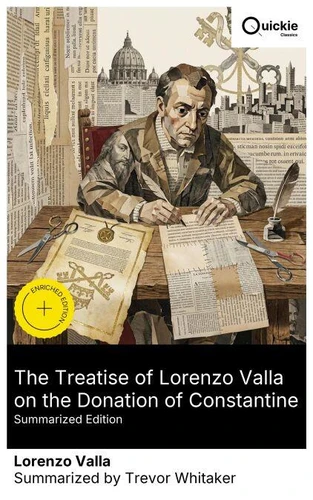
The Treatise of Lorenzo Valla on the Donation of Constantine (Summarized Edition). Enriched edition. How Renaissance Philology Unmasked a Medieval Forgery and Challenged Church Power
Par : , , ,Formats :
Disponible dans votre compte client Decitre ou Furet du Nord dès validation de votre commande. Le format ePub est :
- Compatible avec une lecture sur My Vivlio (smartphone, tablette, ordinateur)
- Compatible avec une lecture sur liseuses Vivlio
- Pour les liseuses autres que Vivlio, vous devez utiliser le logiciel Adobe Digital Edition. Non compatible avec la lecture sur les liseuses Kindle, Remarkable et Sony
 , qui est-ce ?
Notre partenaire de plateforme de lecture numérique où vous retrouverez l'ensemble de vos ebooks gratuitement
Pour en savoir plus sur nos ebooks, consultez notre aide en ligne ici
C'est si simple ! Lisez votre ebook avec l'app Vivlio sur votre tablette, mobile ou ordinateur :

- Nombre de pages98
- FormatePub
- ISBN859-65--4787695-3
- EAN8596547876953
- Date de parution10/01/2026
- Protection num.Digital Watermarking
- Taille951 Ko
- Infos supplémentairesepub
- ÉditeurQUICKIE CLASSICS
Résumé
In The treatise of Lorenzo Valla on the Donation of Constantine, the humanist subjects the most consequential medieval charter to a stringent philological audit. By scrutinizing vocabulary, syntax, and legal formulae, he shows the Latin to be medieval, not Constantinian, exposing anachronistic offices, titles, and procedures. Fusing Ciceronian elegance with forensic invective, Valla places textual evidence above tradition, a hallmark of early Renaissance ad fontes scholarship.
Valla, trained in rhetoric and philology and moving between curial and courtly service, composed the treatise amid the contests of the 1440s. As secretary to Alfonso of Aragon in Naples, he deployed philology against papal temporal claims. His Elegantiae and later scriptural notes reveal the habits behind it: classical norms, anti-scholastic polemic, and institutional acuity. Recommended to readers of Renaissance humanism, church history, and legal culture, this work models the power of language history to test authority.
It remains a concise primer in critical method and a landmark in the politics of knowledge. Anyone curious how arguments about words reshape institutions will find it incisive, learned, and bracing. Quickie Classics summarizes timeless works with precision, preserving the author's voice and keeping the prose clear, fast, and readable-distilled, never diluted. Enriched Edition extras: Introduction · Synopsis · Historical Context · Author Biography · Brief Analysis · 4 Reflection Q&As · Editorial Footnotes.
Valla, trained in rhetoric and philology and moving between curial and courtly service, composed the treatise amid the contests of the 1440s. As secretary to Alfonso of Aragon in Naples, he deployed philology against papal temporal claims. His Elegantiae and later scriptural notes reveal the habits behind it: classical norms, anti-scholastic polemic, and institutional acuity. Recommended to readers of Renaissance humanism, church history, and legal culture, this work models the power of language history to test authority.
It remains a concise primer in critical method and a landmark in the politics of knowledge. Anyone curious how arguments about words reshape institutions will find it incisive, learned, and bracing. Quickie Classics summarizes timeless works with precision, preserving the author's voice and keeping the prose clear, fast, and readable-distilled, never diluted. Enriched Edition extras: Introduction · Synopsis · Historical Context · Author Biography · Brief Analysis · 4 Reflection Q&As · Editorial Footnotes.