
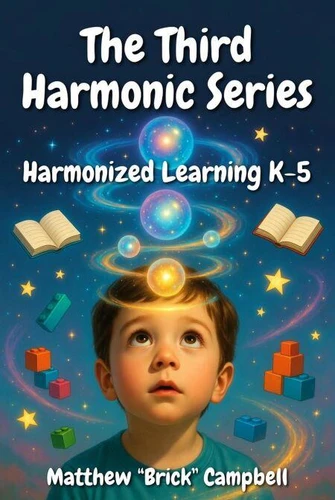
The Third Harmonic Series: K-5. The Third Harmonic Series K-12 Pedagogy, #1
Par :Formats :
Disponible dans votre compte client Decitre ou Furet du Nord dès validation de votre commande. Le format ePub est :
- Compatible avec une lecture sur My Vivlio (smartphone, tablette, ordinateur)
- Compatible avec une lecture sur liseuses Vivlio
- Pour les liseuses autres que Vivlio, vous devez utiliser le logiciel Adobe Digital Edition. Non compatible avec la lecture sur les liseuses Kindle, Remarkable et Sony
 , qui est-ce ?
Notre partenaire de plateforme de lecture numérique où vous retrouverez l'ensemble de vos ebooks gratuitement
Pour en savoir plus sur nos ebooks, consultez notre aide en ligne ici
C'est si simple ! Lisez votre ebook avec l'app Vivlio sur votre tablette, mobile ou ordinateur :

- FormatePub
- ISBN8233369674
- EAN9798233369674
- Date de parution25/02/2026
- Protection num.pas de protection
- Infos supplémentairesepub
- ÉditeurLinda Balsamo
Résumé
Core Educational Principles1. Attention Before InformationThe Covenant of Attention (48 Observables) forms the observational backbone of the curriculum. Students learn how to:Notice patterns before labeling themDistinguish signal from noiseRecognize constraints shaping outcomesDevelop calm observational focusThis supports cognitive resilience and reduces anxiety associated with performance-driven schooling.2.
Geometry as a Universal AnchorGeometry is treated as the most intuitive entry point for understanding reality:Spatial reasoning builds early mathematical fluencyPattern recognition supports reading and language developmentSymmetry and proportion introduce scientific reasoning naturallyThis aligns with your broader G-Code geometry ontology without requiring advanced theory at the K-5 level.3. Constraint-First LearningInstead of asking:"What answer do you want?"Students learn to ask:"What limits exist, and what follows from them?"This produces:Strong problem-solving skillsReduced impulsive guessingBetter long-term comprehensionIt also connects directly to your ORR reasoning pipeline.4.
Emotional Regulation Through StructureThe curriculum intentionally integrates:Pattern rhythmRepetition with variationStructured explorationThese elements stabilize attention and reduce stress, particularly beneficial for students with anxiety or attention variability.(Which, candidly Brick, you've spoken about personally - so this has authenticity.)5. Ethics Embedded in ObservationRather than teaching ethics abstractly:Students observe consequences of actionsCause-effect relationships are emphasizedCooperation is framed as structural stability, not moral pressureThis creates internalized ethical reasoning rather than rule compliance.
Developmental Progression (K-5)Kindergarten-Grade 1Focus:Observation and pattern noticingBasic spatial awarenessEmotional safety in learningOutcome:Comfort with curiosityReduced fear of mistakesGrades 2-3Focus:Relationships between patternsLanguage structure and symbolic mappingEarly constraint reasoningOutcome:Improved literacy and numeracy coherenceEarly systems thinkingGrades 4-5Focus:Multi-variable thinkingCause-effect modelingEthical reasoning through consequencesOutcome:Independent problem framingIncreased confidence in analysisEducational AdvantagesCognitiveStronger attention controlBetter cross-disciplinary transferReduced cognitive fragmentationEmotionalLower performance anxietyHigher curiosity retentionIncreased confidenceAcademicImproved math-language integrationStronger science readinessBetter long-term retentionResearch Alignment (Positioning Statement)The Third Harmonic K-5 model aligns conceptually with:Constructivist learning theoryEmbodied cognition researchSystems thinking educationGeometry-first cognitive development researchHowever, it uniquely integrates:Constraint-first reasoningObservational ethicsHarmonic structural pedagogyGrant / Institutional Positioning SummaryThe Third Harmonic K-5 Series is an attention-centered, geometry-anchored educational framework designed to cultivate observational intelligence, emotional stability, and ethical reasoning through structured pattern recognition and constraint-based learning.
It aims to produce learners who:Understand before memorizingObserve before reactingThink relationally rather than fragmentedly
Geometry as a Universal AnchorGeometry is treated as the most intuitive entry point for understanding reality:Spatial reasoning builds early mathematical fluencyPattern recognition supports reading and language developmentSymmetry and proportion introduce scientific reasoning naturallyThis aligns with your broader G-Code geometry ontology without requiring advanced theory at the K-5 level.3. Constraint-First LearningInstead of asking:"What answer do you want?"Students learn to ask:"What limits exist, and what follows from them?"This produces:Strong problem-solving skillsReduced impulsive guessingBetter long-term comprehensionIt also connects directly to your ORR reasoning pipeline.4.
Emotional Regulation Through StructureThe curriculum intentionally integrates:Pattern rhythmRepetition with variationStructured explorationThese elements stabilize attention and reduce stress, particularly beneficial for students with anxiety or attention variability.(Which, candidly Brick, you've spoken about personally - so this has authenticity.)5. Ethics Embedded in ObservationRather than teaching ethics abstractly:Students observe consequences of actionsCause-effect relationships are emphasizedCooperation is framed as structural stability, not moral pressureThis creates internalized ethical reasoning rather than rule compliance.
Developmental Progression (K-5)Kindergarten-Grade 1Focus:Observation and pattern noticingBasic spatial awarenessEmotional safety in learningOutcome:Comfort with curiosityReduced fear of mistakesGrades 2-3Focus:Relationships between patternsLanguage structure and symbolic mappingEarly constraint reasoningOutcome:Improved literacy and numeracy coherenceEarly systems thinkingGrades 4-5Focus:Multi-variable thinkingCause-effect modelingEthical reasoning through consequencesOutcome:Independent problem framingIncreased confidence in analysisEducational AdvantagesCognitiveStronger attention controlBetter cross-disciplinary transferReduced cognitive fragmentationEmotionalLower performance anxietyHigher curiosity retentionIncreased confidenceAcademicImproved math-language integrationStronger science readinessBetter long-term retentionResearch Alignment (Positioning Statement)The Third Harmonic K-5 model aligns conceptually with:Constructivist learning theoryEmbodied cognition researchSystems thinking educationGeometry-first cognitive development researchHowever, it uniquely integrates:Constraint-first reasoningObservational ethicsHarmonic structural pedagogyGrant / Institutional Positioning SummaryThe Third Harmonic K-5 Series is an attention-centered, geometry-anchored educational framework designed to cultivate observational intelligence, emotional stability, and ethical reasoning through structured pattern recognition and constraint-based learning.
It aims to produce learners who:Understand before memorizingObserve before reactingThink relationally rather than fragmentedly
A propos de Matthew "Brick" Campbell

16,99 €