SOLDES
Jusqu'à -70% sur une sélection d'articles*

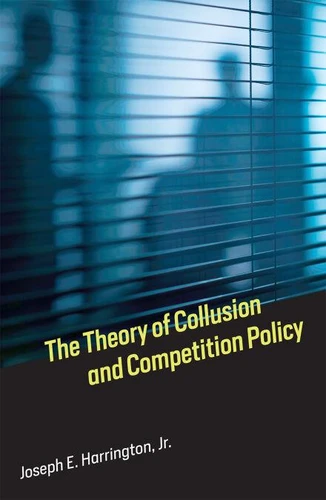
The Theory of Collusion and Competition Policy
Par :Formats :
Disponible dans votre compte client Decitre ou Furet du Nord dès validation de votre commande. Le format ePub protégé est :
- Compatible avec une lecture sur My Vivlio (smartphone, tablette, ordinateur)
- Compatible avec une lecture sur liseuses Vivlio
- Pour les liseuses autres que Vivlio, vous devez utiliser le logiciel Adobe Digital Edition. Non compatible avec la lecture sur les liseuses Kindle, Remarkable et Sony
- Non compatible avec un achat hors France métropolitaine
 , qui est-ce ?
Notre partenaire de plateforme de lecture numérique où vous retrouverez l'ensemble de vos ebooks gratuitement
Pour en savoir plus sur nos ebooks, consultez notre aide en ligne ici
C'est si simple ! Lisez votre ebook avec l'app Vivlio sur votre tablette, mobile ou ordinateur :

- Nombre de pages144
- FormatePub
- ISBN978-0-262-34300-8
- EAN9780262343008
- Date de parution24/11/2017
- Protection num.Adobe DRM
- Taille2 Mo
- Infos supplémentairesepub
- ÉditeurThe MIT Press
Résumé
A review of the theoretical research on unlawful collusion, focusing on the impact and optimal design of competition law and enforcement. Collusion occurs when firms in a market coordinate their behavior for the purpose of producing a supracompetitive outcome. The literature on the theory of collusion is deep and broad but most of that work does not take account of the possible illegality of collusion.
Recently, there has been a growing body of research that explicitly focuses on collusion that runs afoul of competition law and thereby makes firms potentially liable for penalties. This book, by an expert on the subject, reviews the theoretical research on unlawful collusion, with a focus on two issues: the impact of competition law and enforcement on whether, how long, and how much firms collude; and the optimal design of competition law and enforcement.
The book begins by discussing general issues that arise when models of collusion take into account competition law and enforcement. It goes on to consider game-theoretic models that encompass the probability of detection and penalties incurred when convicted, and examines how these policy instruments affect the frequency of cartels, cartel duration, cartel participation, and collusive prices. The book then considers the design of competition law and enforcement, examining such topics as the formula for penalties and leniency programs.
The book concludes with suggested future lines of inquiry into illegal collusion.
Recently, there has been a growing body of research that explicitly focuses on collusion that runs afoul of competition law and thereby makes firms potentially liable for penalties. This book, by an expert on the subject, reviews the theoretical research on unlawful collusion, with a focus on two issues: the impact of competition law and enforcement on whether, how long, and how much firms collude; and the optimal design of competition law and enforcement.
The book begins by discussing general issues that arise when models of collusion take into account competition law and enforcement. It goes on to consider game-theoretic models that encompass the probability of detection and penalties incurred when convicted, and examines how these policy instruments affect the frequency of cartels, cartel duration, cartel participation, and collusive prices. The book then considers the design of competition law and enforcement, examining such topics as the formula for penalties and leniency programs.
The book concludes with suggested future lines of inquiry into illegal collusion.
A propos de Joseph E. Harrington
107,92 €