
Filippo Carlà-Uhink is Professor for Ancient History at the University of Potsdam and a specialist in Roman history (especially 3rd-4th c. CE), cultural history of the ancient world, and classical reception studies.
Christian Rollinger ist Akademischer Rat an der Universität Trier. Er forscht zu antiken Formen monarchischer Herrschaft in Hellenismus und Spätantike, zur Kultur-, Sozial- und Wirtschaftsgeschichte der Späten Republik und frühen Kaiserzeit sowie zur maritimen Geschichte der Antike und zu Antikenrezeption in der Popkultur, besonders im Videospiel.
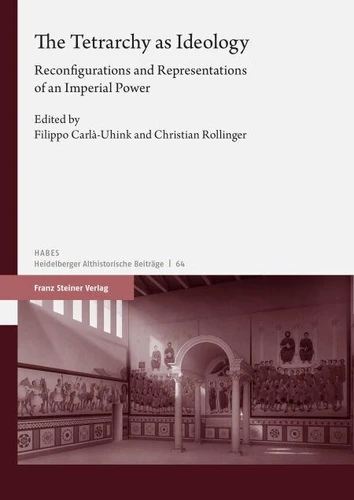
The Tetrarchy as Ideology. Reconfigurations and Representations of an Imperial Power
Par : ,Formats :
Disponible dans votre compte client Decitre ou Furet du Nord dès validation de votre commande. Le format PDF est :
- Compatible avec une lecture sur My Vivlio (smartphone, tablette, ordinateur)
- Compatible avec une lecture sur liseuses Vivlio
- Pour les liseuses autres que Vivlio, vous devez utiliser le logiciel Adobe Digital Edition. Non compatible avec la lecture sur les liseuses Kindle, Remarkable et Sony
 , qui est-ce ?
Notre partenaire de plateforme de lecture numérique où vous retrouverez l'ensemble de vos ebooks gratuitement
Pour en savoir plus sur nos ebooks, consultez notre aide en ligne ici
C'est si simple ! Lisez votre ebook avec l'app Vivlio sur votre tablette, mobile ou ordinateur :

- Nombre de pages382
- FormatPDF
- ISBN978-3-515-13403-3
- EAN9783515134033
- Date de parution19/01/2023
- Protection num.Digital Watermarking
- Taille8 Mo
- Infos supplémentairespdf
- ÉditeurFranz Steiner
Résumé
The 'Tetrarchy', the modern name assigned to the period of Roman history that started with the emperor Diocletian and ended with Constantine I, has been a much-studied and much-debated field of the Roman Empire. Debate, however, has focused primarily on whether it was a true 'system' of government, or rather a collection of ad-hoc measures undertaken to stabilise the empire after the troubled period of the 3rd century CE.
The papers collected here aim to go beyond this question and to present an innovative approach to a fascinating period of Roman history by understanding the Tetrarchy not as a system of government, but primarily as a political language. Their focus thus lies on the language and ideology of the imperial college and court, on the performance of power in imperial ceremonies, the representation of the emperors and their enemies in the provinces of the Roman world, as well as on the afterlife of Tetrarchic power in the Constantinian period.
The papers collected here aim to go beyond this question and to present an innovative approach to a fascinating period of Roman history by understanding the Tetrarchy not as a system of government, but primarily as a political language. Their focus thus lies on the language and ideology of the imperial college and court, on the performance of power in imperial ceremonies, the representation of the emperors and their enemies in the provinces of the Roman world, as well as on the afterlife of Tetrarchic power in the Constantinian period.