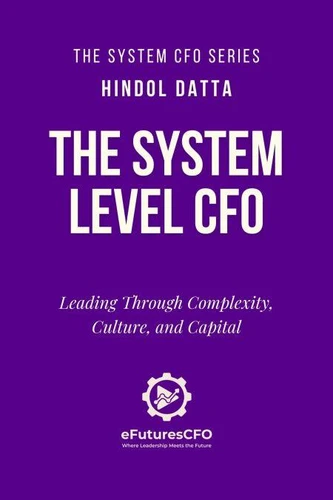
The System Level CFO is a comprehensive, practitioner-driven framework for modern financial leadership. Drawing on 25 years of CFO and finance executive experience across gaming, cybersecurity, SaaS, manufacturing, logistics, edtech, and healthcare technology - including roles at Atari, Singularity University alongside Peter Diamandis and Ray Kurzweil, and BeyondID - Hindol Datta synthesizes systems thinking, complexity science, the Theory of Constraints, decision theory, behavioral economics, and real options theory into a coherent operating philosophy for finance leaders at every stage of organizational growth.
The book is organized into four sections that build on one another intentionally. Section I establishes the systemic foundation: the 90-day Assess-Align-Architect model for entering any new CFO role, the Three-Lens Model for simultaneously reading financial health, operational flow, and behavioral culture, and the CEO-CFO partnership as the engine of organizational execution. Section II covers the architecture of execution: enterprise systems design using the Theory of Constraints, rolling-forecast methodology, scenario-lattice planning, and the transition from backward-looking close processes to forward-looking foresight functions.
Section III addresses capital and value architecture: AI governance and automation, predictive finance and scenario modeling, capital structure optimization, building for optionality, and the CFO's role in valuation and value creation for venture-backed, private equity-backed, and public company environments. Section IV, Cognitive Finance, is where the book distinguishes itself most sharply: decision architecture under uncertainty, second-order thinking, real options theory in capital allocation, the geometry of organizational time, and how learning speed becomes a durable competitive advantage.
Readers will find practical, field-tested instruments throughout, including the System Health Map, the Rhythm Map, the Entropy Index, the Resilience Ratio, the Forecast Half-Life metric, the CFO Operating Scorecard, boardroom simulations, and a full Systems Thinking CFO Toolkit with operational assessments and chapter-level diagnostics. Who This Book Is ForThis book is essential reading for CFOs and finance executives navigating high-growth, venture-backed, or private equity-backed environments.
It is equally relevant to chief executives who want to understand what a true strategic finance partnership looks like, to private equity and venture capital investors who evaluate organizational health and management quality in portfolio companies, and to MBA students and emerging finance leaders building the intellectual foundation for serious careers in financial leadership. The System Level CFO is not a theoretical text.
It is a practitioner's operating manual, written by someone who has led finance through explosive revenue growth, post-merger integration, ERP transformation, AI governance, capital raises, and leadership succession. Every framework in these pages was forged in the field. The numbers will always tell you something. The finance leader who has learned to read the system behind them will always be the one the organization turns to when clarity matters most - and in a world of accelerating complexity, that moment arrives more often than anyone expects.
The System Level CFO is a comprehensive, practitioner-driven framework for modern financial leadership. Drawing on 25 years of CFO and finance executive experience across gaming, cybersecurity, SaaS, manufacturing, logistics, edtech, and healthcare technology - including roles at Atari, Singularity University alongside Peter Diamandis and Ray Kurzweil, and BeyondID - Hindol Datta synthesizes systems thinking, complexity science, the Theory of Constraints, decision theory, behavioral economics, and real options theory into a coherent operating philosophy for finance leaders at every stage of organizational growth.
The book is organized into four sections that build on one another intentionally. Section I establishes the systemic foundation: the 90-day Assess-Align-Architect model for entering any new CFO role, the Three-Lens Model for simultaneously reading financial health, operational flow, and behavioral culture, and the CEO-CFO partnership as the engine of organizational execution. Section II covers the architecture of execution: enterprise systems design using the Theory of Constraints, rolling-forecast methodology, scenario-lattice planning, and the transition from backward-looking close processes to forward-looking foresight functions.
Section III addresses capital and value architecture: AI governance and automation, predictive finance and scenario modeling, capital structure optimization, building for optionality, and the CFO's role in valuation and value creation for venture-backed, private equity-backed, and public company environments. Section IV, Cognitive Finance, is where the book distinguishes itself most sharply: decision architecture under uncertainty, second-order thinking, real options theory in capital allocation, the geometry of organizational time, and how learning speed becomes a durable competitive advantage.
Readers will find practical, field-tested instruments throughout, including the System Health Map, the Rhythm Map, the Entropy Index, the Resilience Ratio, the Forecast Half-Life metric, the CFO Operating Scorecard, boardroom simulations, and a full Systems Thinking CFO Toolkit with operational assessments and chapter-level diagnostics. Who This Book Is ForThis book is essential reading for CFOs and finance executives navigating high-growth, venture-backed, or private equity-backed environments.
It is equally relevant to chief executives who want to understand what a true strategic finance partnership looks like, to private equity and venture capital investors who evaluate organizational health and management quality in portfolio companies, and to MBA students and emerging finance leaders building the intellectual foundation for serious careers in financial leadership. The System Level CFO is not a theoretical text.
It is a practitioner's operating manual, written by someone who has led finance through explosive revenue growth, post-merger integration, ERP transformation, AI governance, capital raises, and leadership succession. Every framework in these pages was forged in the field. The numbers will always tell you something. The finance leader who has learned to read the system behind them will always be the one the organization turns to when clarity matters most - and in a world of accelerating complexity, that moment arrives more often than anyone expects.


 , qui est-ce ?