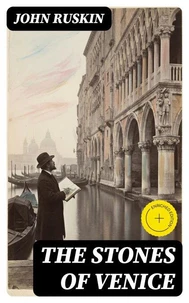
The Stones of Venice. Study of Venetian Architecture
Par :Formats :
Disponible dans votre compte client Decitre ou Furet du Nord dès validation de votre commande. Le format ePub est :
- Compatible avec une lecture sur My Vivlio (smartphone, tablette, ordinateur)
- Compatible avec une lecture sur liseuses Vivlio
- Pour les liseuses autres que Vivlio, vous devez utiliser le logiciel Adobe Digital Edition. Non compatible avec la lecture sur les liseuses Kindle, Remarkable et Sony
 , qui est-ce ?
Notre partenaire de plateforme de lecture numérique où vous retrouverez l'ensemble de vos ebooks gratuitement
Pour en savoir plus sur nos ebooks, consultez notre aide en ligne ici
C'est si simple ! Lisez votre ebook avec l'app Vivlio sur votre tablette, mobile ou ordinateur :

- Nombre de pages1031
- FormatePub
- ISBN859-65--4778614-6
- EAN8596547786146
- Date de parution22/12/2023
- Protection num.Digital Watermarking
- Taille7 Mo
- Infos supplémentairesepub
- ÉditeurGOOD PRESS
Résumé
In 'The Stones of Venice, ' John Ruskin explores the intricate relationship between architecture, society, and morality, presenting a comprehensive critique of Venetian Gothic architecture. Through rich descriptions and detailed illustrations, Ruskin examines the aesthetic principles underlying the city's edifices and their cultural significance. The book stands as a manifesto for the importance of craftsmanship and beauty in architecture, juxtaposing the splendor of Venice with the emerging industrial practices of his time.
Written in a highly ornate and poetic style, Ruskin'Äôs work transcends mere architectural criticism, delving into philosophical reflections on art and its moral implications, thus rooting the narrative firmly within the Victorian context of art appreciation and social critique. John Ruskin (1819-1900), a prominent art critic, social thinker, and leading figure of the Victorian era, was deeply influenced by his experiences in Venice and his passion for art.
His travels in Italy profoundly impacted his understanding of aesthetic beauty and its alignment with ethical living. Ruskin's advocacy for the Arts and Crafts movement, along with his fierce resistance to industrialization and mass production, is contextualized through this work, which serves not only as a celebration of Venice's architectural grandeur but also as a cautionary tale against the loss of artistry in the modern world.
Readers seeking a deeper understanding of the intersection between art, architecture, and morality will find 'The Stones of Venice' an indispensable text. It invites reflection on the broader human experience and underscores the significance of preserving beauty in our environments. In a world increasingly dominated by utilitarianism, Ruskin'Äôs stirring prose and passionate arguments make this work not just relevant but essential for anyone interested in art's power to shape society.
Written in a highly ornate and poetic style, Ruskin'Äôs work transcends mere architectural criticism, delving into philosophical reflections on art and its moral implications, thus rooting the narrative firmly within the Victorian context of art appreciation and social critique. John Ruskin (1819-1900), a prominent art critic, social thinker, and leading figure of the Victorian era, was deeply influenced by his experiences in Venice and his passion for art.
His travels in Italy profoundly impacted his understanding of aesthetic beauty and its alignment with ethical living. Ruskin's advocacy for the Arts and Crafts movement, along with his fierce resistance to industrialization and mass production, is contextualized through this work, which serves not only as a celebration of Venice's architectural grandeur but also as a cautionary tale against the loss of artistry in the modern world.
Readers seeking a deeper understanding of the intersection between art, architecture, and morality will find 'The Stones of Venice' an indispensable text. It invites reflection on the broader human experience and underscores the significance of preserving beauty in our environments. In a world increasingly dominated by utilitarianism, Ruskin'Äôs stirring prose and passionate arguments make this work not just relevant but essential for anyone interested in art's power to shape society.
A propos de John Ruskin



0,99 €
Sesame and Lilies
E-book
0,99 €