SOLDES
Jusqu'à -70% sur une sélection d'articles*

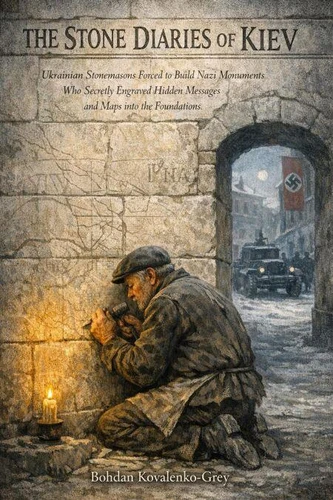
THE STONE DIARIES OF KIEV: Ukrainian Stonemasons Forced to Build Nazi Monuments Who Secretly Engraved Hidden Messages and Maps into the Foundations
Par :Formats :
Disponible dans votre compte client Decitre ou Furet du Nord dès validation de votre commande. Le format ePub est :
- Compatible avec une lecture sur My Vivlio (smartphone, tablette, ordinateur)
- Compatible avec une lecture sur liseuses Vivlio
- Pour les liseuses autres que Vivlio, vous devez utiliser le logiciel Adobe Digital Edition. Non compatible avec la lecture sur les liseuses Kindle, Remarkable et Sony
 , qui est-ce ?
Notre partenaire de plateforme de lecture numérique où vous retrouverez l'ensemble de vos ebooks gratuitement
Pour en savoir plus sur nos ebooks, consultez notre aide en ligne ici
C'est si simple ! Lisez votre ebook avec l'app Vivlio sur votre tablette, mobile ou ordinateur :

- FormatePub
- ISBN8235403666
- EAN9798235403666
- Date de parution06/05/2026
- Protection num.pas de protection
- Infos supplémentairesepub
- ÉditeurIoakim Ioakim
Résumé
In October 1941, as the German occupation of Kyiv tightened its grip over the ruins of a bombed city, master stonemason Mykola Kovalenko reported for forced labour at the construction site on the Khreshchatyk. He brought his tools. He brought, concealed in the habits of his craft, something else. Working under the direction of the Organization Todt, Mykola and a small circle of fellow craftsmen were required to build the physical infrastructure of the Nazi administration: monumental limestone offices, administrative headquarters, the hard stone bones of an occupation intended to last a generation.
They built what they were told to build. And in the foundations, in the sealed back faces of the stones, in the rubble fill of the interior walls, they cut something the occupiers never saw. A record. Dates. Numbers. Names. Maps of the extermination sites, the labour camps, the convoy routes. The figure 33, 771, for the ravine at Babi Yar. The location of the Syrets concentration camp. The provisions of the Generalplan Ost, the German plan to depopulate Ukraine over the coming decades.
Everything that the newspapers did not print and the radio did not say, encoded in the cartographic and numerical notation of the stonemason's trade and sealed inside the walls of the buildings that were meant to express the permanence of the conquest. Into this effort came a civil engineer with access to German administrative plans, a librarian who designed the classification system for a library no one was supposed to find, and a network of women who moved the information through the occupied city in fragments of carved limestone small enough to hide in a shoe. The Stone Diaries of Kiev is the true story of one of the most extraordinary acts of archival intelligence in the history of the Second World War, recovered from declassified German records, from a family notebook carried out of Kyiv in 1944, and from the limestone walls of buildings that have been waiting, for sixty years, to be read. The stone held everything.
This is what it says.
They built what they were told to build. And in the foundations, in the sealed back faces of the stones, in the rubble fill of the interior walls, they cut something the occupiers never saw. A record. Dates. Numbers. Names. Maps of the extermination sites, the labour camps, the convoy routes. The figure 33, 771, for the ravine at Babi Yar. The location of the Syrets concentration camp. The provisions of the Generalplan Ost, the German plan to depopulate Ukraine over the coming decades.
Everything that the newspapers did not print and the radio did not say, encoded in the cartographic and numerical notation of the stonemason's trade and sealed inside the walls of the buildings that were meant to express the permanence of the conquest. Into this effort came a civil engineer with access to German administrative plans, a librarian who designed the classification system for a library no one was supposed to find, and a network of women who moved the information through the occupied city in fragments of carved limestone small enough to hide in a shoe. The Stone Diaries of Kiev is the true story of one of the most extraordinary acts of archival intelligence in the history of the Second World War, recovered from declassified German records, from a family notebook carried out of Kyiv in 1944, and from the limestone walls of buildings that have been waiting, for sixty years, to be read. The stone held everything.
This is what it says.