They didn't just wake up an alien parasite. They woke up a god. Duke Ward cleans up the messes that kill everyone else. A deep-void hazardous environment remover with fourteen years in the trade, he wades into dead space stations with a fifty-pound hydraulic shear and a plasma-arc welder and takes apart whatever went wrong. He has one rule, learned the hard way: everything can be taken apart. Then he's sent to Outpost Ouroboros. The drill team didn't strike ore.
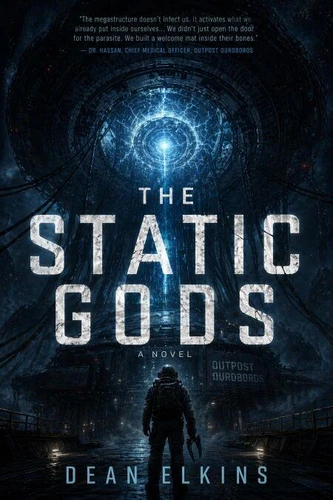
They punched into a 400-million-year-old megastructure and woke the thing sleeping inside it. The crew calls it the Static: an ancient intelligence that doesn't want to kill you. It wants to keep you. Forever. It preserves entire civilizations by fusing them into a flawless lattice of frozen flesh and crystalline machinery, and the crew of Ouroboros has already been rewritten into a choir of interconnected "Husks." Now the megastructure is spooling up a broadcast aimed at Earth, an invitation to perfect, eternal stasis for eight billion people. The alien lattice is already threading through Duke's nervous system, rewriting him into its finest instrument, and the closer he gets to the Focal Node at the station's heart, the sweeter the song sounds.
He has no army. No chosen-one destiny. No way out. What he has is his tools, a dying charge, and one blue-collar truth the machine four hundred million years old could never understand: you can't fix something that's been made perfect. Sometimes the only way to save the world is to break the machine. The Static Gods is a relentless collision of cosmic horror and gritty, hard-edged science fiction, perfect for readers of Dead Space, Event Horizon, Warhammer 40K, and the works of Jeremy Robinson and Peter Clines.
It's a story about entropy, defiance, and the messy, chaotic beauty of things that refuse to be preserved. Still fixing. That's all I ever do.
They didn't just wake up an alien parasite. They woke up a god. Duke Ward cleans up the messes that kill everyone else. A deep-void hazardous environment remover with fourteen years in the trade, he wades into dead space stations with a fifty-pound hydraulic shear and a plasma-arc welder and takes apart whatever went wrong. He has one rule, learned the hard way: everything can be taken apart. Then he's sent to Outpost Ouroboros. The drill team didn't strike ore.
They punched into a 400-million-year-old megastructure and woke the thing sleeping inside it. The crew calls it the Static: an ancient intelligence that doesn't want to kill you. It wants to keep you. Forever. It preserves entire civilizations by fusing them into a flawless lattice of frozen flesh and crystalline machinery, and the crew of Ouroboros has already been rewritten into a choir of interconnected "Husks." Now the megastructure is spooling up a broadcast aimed at Earth, an invitation to perfect, eternal stasis for eight billion people. The alien lattice is already threading through Duke's nervous system, rewriting him into its finest instrument, and the closer he gets to the Focal Node at the station's heart, the sweeter the song sounds.
He has no army. No chosen-one destiny. No way out. What he has is his tools, a dying charge, and one blue-collar truth the machine four hundred million years old could never understand: you can't fix something that's been made perfect. Sometimes the only way to save the world is to break the machine. The Static Gods is a relentless collision of cosmic horror and gritty, hard-edged science fiction, perfect for readers of Dead Space, Event Horizon, Warhammer 40K, and the works of Jeremy Robinson and Peter Clines.
It's a story about entropy, defiance, and the messy, chaotic beauty of things that refuse to be preserved. Still fixing. That's all I ever do.

 , qui est-ce ?