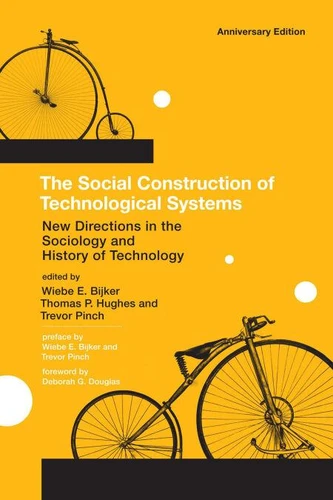
The Social Construction of Technological Systems, anniversary edition. New Directions in the Sociology and History of Technology
Par : , , ,Formats :
Disponible dans votre compte client Decitre ou Furet du Nord dès validation de votre commande. Le format ePub protégé est :
- Compatible avec une lecture sur My Vivlio (smartphone, tablette, ordinateur)
- Compatible avec une lecture sur liseuses Vivlio
- Pour les liseuses autres que Vivlio, vous devez utiliser le logiciel Adobe Digital Edition. Non compatible avec la lecture sur les liseuses Kindle, Remarkable et Sony
- Non compatible avec un achat hors France métropolitaine
 , qui est-ce ?
Notre partenaire de plateforme de lecture numérique où vous retrouverez l'ensemble de vos ebooks gratuitement
Pour en savoir plus sur nos ebooks, consultez notre aide en ligne ici
C'est si simple ! Lisez votre ebook avec l'app Vivlio sur votre tablette, mobile ou ordinateur :

- Nombre de pages470
- FormatePub
- ISBN978-0-262-30087-2
- EAN9780262300872
- Date de parution18/05/2012
- Protection num.Adobe DRM
- Taille7 Mo
- Infos supplémentairesepub
- ÉditeurThe MIT Press
Résumé
An anniversary edition of an influential book that introduced a groundbreaking approach to the study of science, technology, and society. This pioneering book, first published in 1987, launched the new field of social studies of technology. It introduced a method of inquiry-social construction of technology, or SCOT-that became a key part of the wider discipline of science and technology studies. The book helped the MIT Press shape its STS list and inspired the Inside Technology series.
The thirteen essays in the book tell stories about such varied technologies as thirteenth-century galleys, eighteenth-century cooking stoves, and twentieth-century missile systems. Taken together, they affirm the fruitfulness of an approach to the study of technology that gives equal weight to technical, social, economic, and political questions, and they demonstrate the illuminating effects of the integration of empirics and theory.
The approaches in this volume-collectively called SCOT (after the volume's title) have since broadened their scope, and twenty-five years after the publication of this book, it is difficult to think of a technology that has not been studied from a SCOT perspective and impossible to think of a technology that cannot be studied that way.
The thirteen essays in the book tell stories about such varied technologies as thirteenth-century galleys, eighteenth-century cooking stoves, and twentieth-century missile systems. Taken together, they affirm the fruitfulness of an approach to the study of technology that gives equal weight to technical, social, economic, and political questions, and they demonstrate the illuminating effects of the integration of empirics and theory.
The approaches in this volume-collectively called SCOT (after the volume's title) have since broadened their scope, and twenty-five years after the publication of this book, it is difficult to think of a technology that has not been studied from a SCOT perspective and impossible to think of a technology that cannot be studied that way.