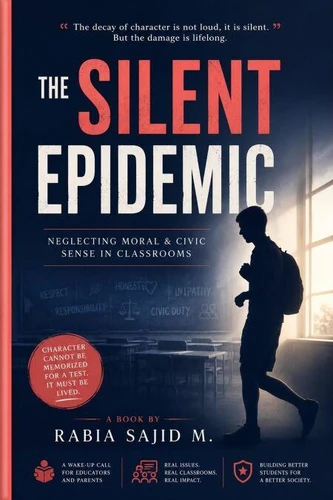
The Silent Epidemic: Neglecting Moral & Civic Sense in ClassroomsSomewhere between the memorized answer and the perfect transcript, something has gone quietly missing from our classrooms. In this deeply personal and urgent book, educator and school founder Rabia Iqbal draws on eight years in the classroom, and the grief that led her to found the Sajid Mehmood Welfare Trust, to confront a crisis hiding in plain sight: a generation raised to chase grades while losing touch with empathy, honesty, and basic civic responsibility.
Weaving firsthand classroom stories with lessons drawn from Japan's Doutoku model of moral education, Rabia makes the case that character cannot be taught through lectures or measured on a report card. It has to be practiced, daily, in the small unglamorous habits of ownership, listening, and kindness that our exam-driven system has quietly crowded out. Part memoir, part practical roadmap, The Silent Epidemic offers educators, parents, and school leaders a clear-eyed diagnosis and a low-cost, achievable path forward, tested in Rabia's own classrooms at Oakridge International School of IT.
It is a call to rebuild our schools as moral hubs once again, before we raise another generation fluent in scoring high and struggling to simply be good to one another.
The Silent Epidemic: Neglecting Moral & Civic Sense in ClassroomsSomewhere between the memorized answer and the perfect transcript, something has gone quietly missing from our classrooms. In this deeply personal and urgent book, educator and school founder Rabia Iqbal draws on eight years in the classroom, and the grief that led her to found the Sajid Mehmood Welfare Trust, to confront a crisis hiding in plain sight: a generation raised to chase grades while losing touch with empathy, honesty, and basic civic responsibility.
Weaving firsthand classroom stories with lessons drawn from Japan's Doutoku model of moral education, Rabia makes the case that character cannot be taught through lectures or measured on a report card. It has to be practiced, daily, in the small unglamorous habits of ownership, listening, and kindness that our exam-driven system has quietly crowded out. Part memoir, part practical roadmap, The Silent Epidemic offers educators, parents, and school leaders a clear-eyed diagnosis and a low-cost, achievable path forward, tested in Rabia's own classrooms at Oakridge International School of IT.
It is a call to rebuild our schools as moral hubs once again, before we raise another generation fluent in scoring high and struggling to simply be good to one another.

 , qui est-ce ?