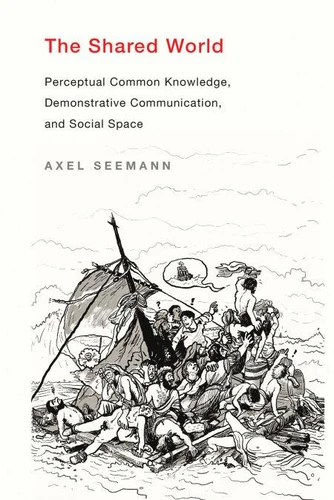
The Shared World. Perceptual Common Knowledge, Demonstrative Communication, and Social Space
Par :Formats :
Disponible dans votre compte client Decitre ou Furet du Nord dès validation de votre commande. Le format ePub protégé est :
- Compatible avec une lecture sur My Vivlio (smartphone, tablette, ordinateur)
- Compatible avec une lecture sur liseuses Vivlio
- Pour les liseuses autres que Vivlio, vous devez utiliser le logiciel Adobe Digital Edition. Non compatible avec la lecture sur les liseuses Kindle, Remarkable et Sony
- Non compatible avec un achat hors France métropolitaine
 , qui est-ce ?
Notre partenaire de plateforme de lecture numérique où vous retrouverez l'ensemble de vos ebooks gratuitement
Pour en savoir plus sur nos ebooks, consultez notre aide en ligne ici
C'est si simple ! Lisez votre ebook avec l'app Vivlio sur votre tablette, mobile ou ordinateur :

- Nombre de pages248
- FormatePub
- ISBN978-0-262-35273-4
- EAN9780262352734
- Date de parution07/05/2019
- Protection num.Adobe DRM
- Taille569 Ko
- Infos supplémentairesepub
- ÉditeurThe MIT Press
Résumé
A novel treatment of the capacity for shared attention, joint action, and perceptual common knowledge. In The Shared World, Axel Seemann offers a new treatment of the capacity to perceive, act on, and know about the world together with others. Seemann argues that creatures capable of joint attention stand in a unique perceptual and epistemic relation to their surroundings; they operate in an environment that they, through their communication with their fellow perceivers, help constitute.
Seemann shows that this relation can be marshaled to address a range of questions about the social aspect of the mind and its perceptual and cognitive capacities. Seemann begins with a conceptual question about a complex kind of sociocognitive phenomenon-perceptual common knowledge-and develops an empirically informed account of the spatial structure of the environment in and about which such knowledge is possible.
In the course of his argument, he addresses such topics as demonstrative reference in communication, common knowledge about jointly perceived objects, and spatial awareness in joint perception and action.
Seemann shows that this relation can be marshaled to address a range of questions about the social aspect of the mind and its perceptual and cognitive capacities. Seemann begins with a conceptual question about a complex kind of sociocognitive phenomenon-perceptual common knowledge-and develops an empirically informed account of the spatial structure of the environment in and about which such knowledge is possible.
In the course of his argument, he addresses such topics as demonstrative reference in communication, common knowledge about jointly perceived objects, and spatial awareness in joint perception and action.