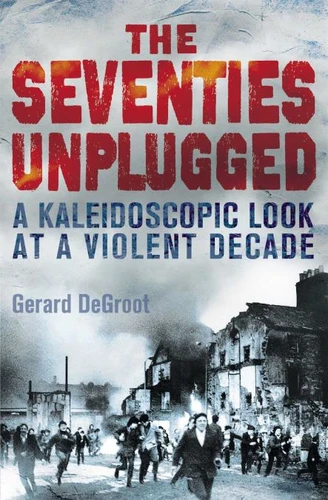
If the 1960s was the decade of peace, love and understanding, the 1970s was the decade of glitter and glam rock. Or was it? Gerard DeGroot peels away the polyester to examine what really happened in a decade that began with the death of Jimi Hendrix and ended with Ronald Reagan in the White House and Margaret Thatcher in 10 Downing Street. Some commentators have written off the Seventies as a period in which nothing happened, yet politically it was a time of great hope.
Dictatorial regimes ended in Portugal, Spain, Nicaragua, Rhodesia and Greece. Accord between nations was established at Camp David, Peking, Moscow, Geneva and Brussels. For feminists, environmentalists and homosexuals, the Seventies was the decade of hope. In cultural terms, it brought the Sydney Opera House, Monty Python, Annie Hall, David Hockney and M. A. S. H. The music, with or without ABBA, was simply brilliant.
But it was also a time of quite extraordinary violence and as the decade continued, the bloodshed and the hate came to dominate, whether in Jonestown, Belfast, Palestine or Cambodia. And while the violence of nations is a constant throughout history, in the 1970s ordinary people seemed to surrender to violence with frightening ease. As the Sixties chickens came home to roost, the Seventies became an era when dreams died, hope was thwarted, problems long ignored finally exploded, and optimism repeatedly crushed gave way to frustration.
Incisive, iconoclastic and hugely entertaining The Seventies Unplugged is popular history at its best.
If the 1960s was the decade of peace, love and understanding, the 1970s was the decade of glitter and glam rock. Or was it? Gerard DeGroot peels away the polyester to examine what really happened in a decade that began with the death of Jimi Hendrix and ended with Ronald Reagan in the White House and Margaret Thatcher in 10 Downing Street. Some commentators have written off the Seventies as a period in which nothing happened, yet politically it was a time of great hope.
Dictatorial regimes ended in Portugal, Spain, Nicaragua, Rhodesia and Greece. Accord between nations was established at Camp David, Peking, Moscow, Geneva and Brussels. For feminists, environmentalists and homosexuals, the Seventies was the decade of hope. In cultural terms, it brought the Sydney Opera House, Monty Python, Annie Hall, David Hockney and M. A. S. H. The music, with or without ABBA, was simply brilliant.
But it was also a time of quite extraordinary violence and as the decade continued, the bloodshed and the hate came to dominate, whether in Jonestown, Belfast, Palestine or Cambodia. And while the violence of nations is a constant throughout history, in the 1970s ordinary people seemed to surrender to violence with frightening ease. As the Sixties chickens came home to roost, the Seventies became an era when dreams died, hope was thwarted, problems long ignored finally exploded, and optimism repeatedly crushed gave way to frustration.
Incisive, iconoclastic and hugely entertaining The Seventies Unplugged is popular history at its best.