OFFRE LISEUSES
Une liseuse achetée = une housse offerte* jusqu'au 21 juin

Nouveauté
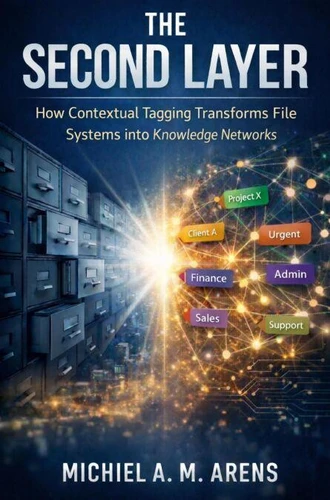
The Second Layer. How Contextual Tagging Transforms File Systems into Knowledge Networks
Par :Formats :
Disponible dans votre compte client Decitre ou Furet du Nord dès validation de votre commande. Le format ePub est :
- Compatible avec une lecture sur My Vivlio (smartphone, tablette, ordinateur)
- Compatible avec une lecture sur liseuses Vivlio
- Pour les liseuses autres que Vivlio, vous devez utiliser le logiciel Adobe Digital Edition. Non compatible avec la lecture sur les liseuses Kindle, Remarkable et Sony
 , qui est-ce ?
Notre partenaire de plateforme de lecture numérique où vous retrouverez l'ensemble de vos ebooks gratuitement
Pour en savoir plus sur nos ebooks, consultez notre aide en ligne ici
C'est si simple ! Lisez votre ebook avec l'app Vivlio sur votre tablette, mobile ou ordinateur :

- Nombre de pages237
- FormatePub
- ISBN978-94-038-8893-4
- EAN9789403888934
- Date de parution24/04/2026
- Protection num.Digital Watermarking
- Taille1 Mo
- Infos supplémentairesepub
- ÉditeurBookmundo
Résumé
Why is finding a file still so difficult?
Despite powerful computers and advanced software, most professionals still organize digital information using hierarchical folders-an approach designed for a simpler, slower world. Today's work is different. Projects overlap, teams collaborate across functions, and documents relate to multiple contexts at once.
The Second Layer explains why traditional folder systems create friction and introduces a powerful alternative: contextual tagging.
Instead of forcing every document into a single location, tagging adds a second layer of organization based on meaning.
Files can be connected to projects, clients, timeframes, and themes simultaneously, transforming static folder structures into flexible knowledge networks. Drawing on insights from cognitive science, information architecture, and real-world digital work, Michiel A. M. Arens shows how this approach reduces search time, lowers cognitive load, and improves visibility across complex work environments. The Second Layer offers a new way to think about digital organization-one that aligns information systems with how modern professionals actually work.
Files can be connected to projects, clients, timeframes, and themes simultaneously, transforming static folder structures into flexible knowledge networks. Drawing on insights from cognitive science, information architecture, and real-world digital work, Michiel A. M. Arens shows how this approach reduces search time, lowers cognitive load, and improves visibility across complex work environments. The Second Layer offers a new way to think about digital organization-one that aligns information systems with how modern professionals actually work.