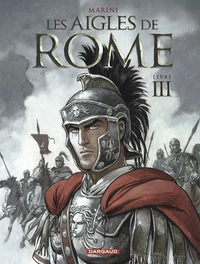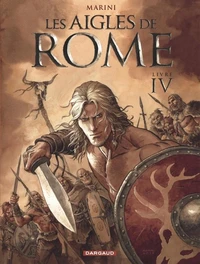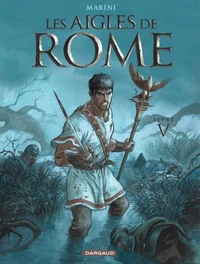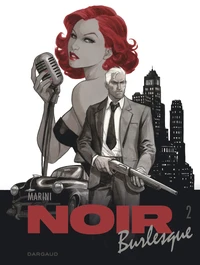



Enrico Marini was born in 1969 in Switzerland near Basel, though an Italian citizen. Throughout his childhood, he created comics for his own amusement; then, at the age of 14, that his friends pushed him to take several art exams. He eventually studied at the Basel Beaux-Arts School for four years, during which his art was influenced by manga and by names such as Hermann, Moebius and Otomo. His career began in 1987 with the new talents section of the Sierre Comics Festival, where his already very accomplished strips got him introduced to newcomer Alpen Publishers.
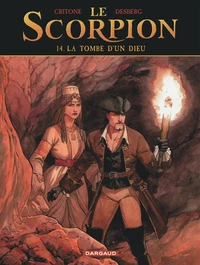
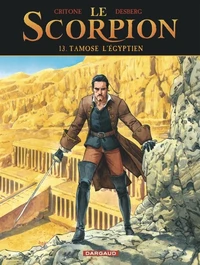
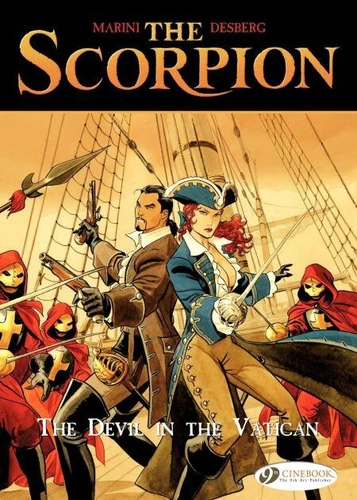
The latter first asked him to illustrate Marelle's La Colombe de la Place Rougea beginning that was followed by a collaboration with Olivier Varèse on three albums, then with Thierry Smolderen on the new series Gypsy. Then came a meeting with Stephen Desberg, which allowed Marini to fulfil a childhood dreamdrawing a western. L'Etoile du Désert reveals, through a new style, the unquestionable talent of two stars of bande dessinéea talent that would shine again in their second collaborative effort, The Scorpion. Stephen Desberg was born in Brussels on 10 September 1954 and started writing scripts under the guidance of Maurice Tillieux.
He collaborated on Tillieux's last Tif et Tondu stories (Le Gouffre interdit in 1978, then Les Passe-montagnes) and then wrote the series on his own until the departure of Willy Maltaite (Will) in 1990. Desberg produced other stories for Will and for his son, Eric, with whom he successively developed a number of series before turning to a more adult type of humour in Carmen Lamour at P&T Productions in 1993.
After this initial period, he worked for Spirou and devised the Mic Mac Adam series for Benn from 1978 onwards, a first attempt at Billy the Cat with Colman in 1979, the fantastic adventures of the angel Arkel for Marc Hardy in 1981 and the retro African atmosphere of Jimmy Toussel for Daniel Desorgher in 1987. At Casterman, he worked in association with Johan De Moor to devise the characters of Gaspard de la nuit and La Vache.
At Lombard, he wrote Le Sang noir for Bernard Vrancken. Dargaud published his Étoile du désert, a saga illustrated by Enrico Marini. Amongst his more recent creations, Le Cercle des sentinelles with Philippe Wurm at Casterman is worth mentioning. However, it is with the kitten Billy the Cat that he has experienced his greatest success after deciding to revive the eight-year-old rough draft in 1987.
These new adventures led to a remarkable series of albums, exactingly produced by a perfectionist cartoonist. They would also attract the attention of millions of European television viewers in a parallel series of animated cartoons.
The latter first asked him to illustrate Marelle's La Colombe de la Place Rougea beginning that was followed by a collaboration with Olivier Varèse on three albums, then with Thierry Smolderen on the new series Gypsy. Then came a meeting with Stephen Desberg, which allowed Marini to fulfil a childhood dreamdrawing a western. L'Etoile du Désert reveals, through a new style, the unquestionable talent of two stars of bande dessinéea talent that would shine again in their second collaborative effort, The Scorpion. Stephen Desberg was born in Brussels on 10 September 1954 and started writing scripts under the guidance of Maurice Tillieux.
He collaborated on Tillieux's last Tif et Tondu stories (Le Gouffre interdit in 1978, then Les Passe-montagnes) and then wrote the series on his own until the departure of Willy Maltaite (Will) in 1990. Desberg produced other stories for Will and for his son, Eric, with whom he successively developed a number of series before turning to a more adult type of humour in Carmen Lamour at P&T Productions in 1993.
After this initial period, he worked for Spirou and devised the Mic Mac Adam series for Benn from 1978 onwards, a first attempt at Billy the Cat with Colman in 1979, the fantastic adventures of the angel Arkel for Marc Hardy in 1981 and the retro African atmosphere of Jimmy Toussel for Daniel Desorgher in 1987. At Casterman, he worked in association with Johan De Moor to devise the characters of Gaspard de la nuit and La Vache.
At Lombard, he wrote Le Sang noir for Bernard Vrancken. Dargaud published his Étoile du désert, a saga illustrated by Enrico Marini. Amongst his more recent creations, Le Cercle des sentinelles with Philippe Wurm at Casterman is worth mentioning. However, it is with the kitten Billy the Cat that he has experienced his greatest success after deciding to revive the eight-year-old rough draft in 1987.
These new adventures led to a remarkable series of albums, exactingly produced by a perfectionist cartoonist. They would also attract the attention of millions of European television viewers in a parallel series of animated cartoons.