
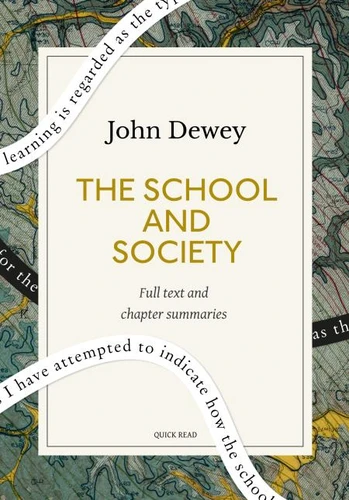
The School and Society: A Quick Read edition. Being three lectures
Par : ,Formats :
Disponible dans votre compte client Decitre ou Furet du Nord dès validation de votre commande. Le format Multi-format est :
- Pour les liseuses autres que Vivlio, vous devez utiliser le logiciel Adobe Digital Edition. Non compatible avec la lecture sur les liseuses Kindle, Remarkable et Sony
 , qui est-ce ?
Notre partenaire de plateforme de lecture numérique où vous retrouverez l'ensemble de vos ebooks gratuitement
Pour en savoir plus sur nos ebooks, consultez notre aide en ligne ici
C'est si simple ! Lisez votre ebook avec l'app Vivlio sur votre tablette, mobile ou ordinateur :

- FormatMulti-format
- ISBN978-2-38582-203-3
- EAN9782385822033
- Date de parution16/02/2024
- Protection num.pas de protection
- Infos supplémentairesMulti-Format
- ÉditeurQuick Read
Résumé
Discover a new way to read classics with Quick Read.
This Quick Read edition includes both the full text and a summary for each chapter.
- Reading time of the complete text: about 2 hours
- Reading time of the summarized text: 5 minutes
The School and Society is a highly influential publication that laid the foundation for John Dewey's later work. In the initial publication, Dewey proposes a psychological, social, and political framework for progressive education, including collaborative practical experimentation as the central element of school work.
He argues that the progressive approach is both an inevitable product of the Industrial Revolution and a natural fit with the psychology of children. The book had almost immediate popularity and influence, with three printings within its first year, comprising 7, 500 copies between them. The first lecture examines the relationship of education and social progress. Dewey argues that, with the coming of the industrial age, many traditional educative processes had been lost.
The third lecture takes on the issue of "waste in education" in a somewhat unusual mode. The work was cited by Édouard Claparède who helped shape a progressive éducation nouvelle in Geneva, Switzerland, in the years leading up to the first world war.
He argues that the progressive approach is both an inevitable product of the Industrial Revolution and a natural fit with the psychology of children. The book had almost immediate popularity and influence, with three printings within its first year, comprising 7, 500 copies between them. The first lecture examines the relationship of education and social progress. Dewey argues that, with the coming of the industrial age, many traditional educative processes had been lost.
The third lecture takes on the issue of "waste in education" in a somewhat unusual mode. The work was cited by Édouard Claparède who helped shape a progressive éducation nouvelle in Geneva, Switzerland, in the years leading up to the first world war.
A propos de Quick Read


4,99 €

4,99 €

4,99 €

4,99 €
4,99 €

4,99 €

4,99 €

4,99 €

4,99 €

4,99 €


4,99 €


4,99 €


4,99 €

4,99 €

4,99 €