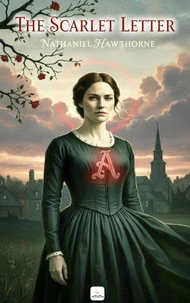
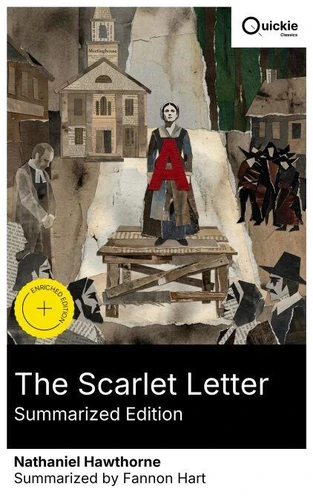
Set in seventeenth-century Puritan Boston, The Scarlet Letter traces Hester Prynne's public shaming for adultery and the hidden complicities binding Dimmesdale, Chillingworth, and the uncanny child Pearl. Hawthorne fashions a dark romance whose ceremonious prose and intrusive narrator weave allegory and psychological realism. Emblems-the crimson A, scaffold, and forest-structure scenes of light and shadow, while the novel, a hallmark of the American Renaissance, interrogates conscience, authority, and the spectacle of punishment.
A descendant of a Salem witch-trials magistrate, Hawthorne long brooded on inherited guilt and New England's theology; those obsessions suffuse his art. His dismissal from the Salem Custom House and the archival habits it fostered shape the book's prefatory frame and its fascination with documents and memory. Years of tale-writing refined his symbolic method, enabling a critique of communal judgment that is historically situated yet inwardly modern.
This work rewards readers who prize dense symbolism, ethical complexity, and an exacting historical imagination. Assign it in courses on American literature, religion, or law; or read it privately for its inexhaustible study of shame, secrecy, and forgiveness. Few works so lucidly reveal how personal desire and public authority collide, making The Scarlet Letter indispensable to any library of serious fiction.
Quickie Classics summarizes timeless works with precision, preserving the author's voice and keeping the prose clear, fast, and readable-distilled, never diluted.
Enriched Edition extras: Introduction · Synopsis · Historical Context · Author Biography · Brief Analysis · 4 Reflection Q&As · Editorial Footnotes.
Set in seventeenth-century Puritan Boston, The Scarlet Letter traces Hester Prynne's public shaming for adultery and the hidden complicities binding Dimmesdale, Chillingworth, and the uncanny child Pearl. Hawthorne fashions a dark romance whose ceremonious prose and intrusive narrator weave allegory and psychological realism. Emblems-the crimson A, scaffold, and forest-structure scenes of light and shadow, while the novel, a hallmark of the American Renaissance, interrogates conscience, authority, and the spectacle of punishment.
A descendant of a Salem witch-trials magistrate, Hawthorne long brooded on inherited guilt and New England's theology; those obsessions suffuse his art. His dismissal from the Salem Custom House and the archival habits it fostered shape the book's prefatory frame and its fascination with documents and memory. Years of tale-writing refined his symbolic method, enabling a critique of communal judgment that is historically situated yet inwardly modern.
This work rewards readers who prize dense symbolism, ethical complexity, and an exacting historical imagination. Assign it in courses on American literature, religion, or law; or read it privately for its inexhaustible study of shame, secrecy, and forgiveness. Few works so lucidly reveal how personal desire and public authority collide, making The Scarlet Letter indispensable to any library of serious fiction.
Quickie Classics summarizes timeless works with precision, preserving the author's voice and keeping the prose clear, fast, and readable-distilled, never diluted.
Enriched Edition extras: Introduction · Synopsis · Historical Context · Author Biography · Brief Analysis · 4 Reflection Q&As · Editorial Footnotes.

 , qui est-ce ?