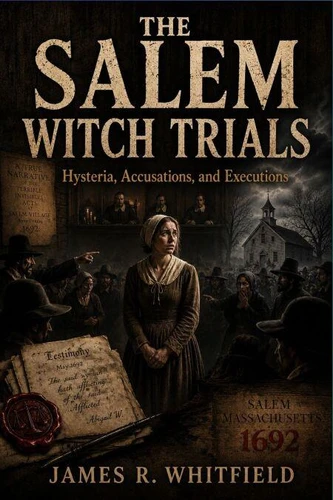
THE SALEM WITCH TRIALS. Hysteria, Accusations, and Executions The Dark Chapter of Colonial Massachusetts That Reveals How Fear and Superstition Can Tear a Community Apart
Par :Formats :
Disponible dans votre compte client Decitre ou Furet du Nord dès validation de votre commande. Le format ePub est :
- Compatible avec une lecture sur My Vivlio (smartphone, tablette, ordinateur)
- Compatible avec une lecture sur liseuses Vivlio
- Pour les liseuses autres que Vivlio, vous devez utiliser le logiciel Adobe Digital Edition. Non compatible avec la lecture sur les liseuses Kindle, Remarkable et Sony
 , qui est-ce ?
Notre partenaire de plateforme de lecture numérique où vous retrouverez l'ensemble de vos ebooks gratuitement
Pour en savoir plus sur nos ebooks, consultez notre aide en ligne ici
C'est si simple ! Lisez votre ebook avec l'app Vivlio sur votre tablette, mobile ou ordinateur :

- FormatePub
- ISBN8905165252
- EAN9798905165252
- Date de parution01/06/2026
- Protection num.pas de protection
- Taille1014 Ko
- Infos supplémentairesepub
- ÉditeurChiify
Résumé
The complete narrative history of the Salem witch trials - mass hysteria, spectral evidence, 19 hangings, and the colonial Massachusetts community that destroyed itself in 1692.
In late January 1692, two girls in the parsonage of the Reverend Samuel Parris began throwing themselves on the floor and crying out against invisible tormentors. Within weeks, village physician William Griggs declared them "under an evil hand." Within months, the Court of Oyer and Terminer had hanged nineteen people on Proctor's Ledge - a site confirmed by researchers only in 2016 - pressed Giles Corey to death under stones over two September days, and imprisoned more than two hundred accused.
The Salem witch trials lasted fifteen months and executed more accused witches than the entire previous history of New England. Historian James R. Whitfield traces the full arc: a colony without a charter since 1684, frontier refugees from King William's War (the destruction of York, Maine in January 1692 sent the orphaned Mercy Lewis directly into the Putnam household), and the factional geography Paul Boyer and Stephen Nissenbaum mapped - western farm families against Salem Town merchants - that gave the accusations their targets.
At the center stood Samuel Parris, John Hathorne, William Stoughton, Cotton Mather, and Governor William Phips, each decision widening a crisis none would stop. Inside this Salem witch trials history: Tituba's confession - her elaborate March 1 testimony, delivered after Samuel Parris allegedly beat her, transformed a household incident into a colony-wide conspiracy (Chapter 4) The machinery of accusation - spectral evidence, the touch test, and the perverse confession-for-survival logic that drove dozens of new arrests monthly through May (Chapter 7) The faces behind the names - Bridget Bishop in her red paragon bodice; Rebecca Nurse, initially acquitted before Stoughton forced reconsideration; Mary Eastey, whose prison petition argued for evidence reform, not her own life (Chapter 17) Giles Corey's gambit - refusing to enter a plea for two days under the stones, preserving his estate where conviction would forfeit it (Chapter 9) The long shadow - Arthur Miller's Crucible, "witch hunt" in American political vocabulary, and the 2017 Proctor's Ledge memorial (Chapter 15) The unfinished exoneration - five executed witches - Susannah Martin, Alice Parker, Margaret Scott, and others - waited until acting Governor Jane Swift signed legislation in 2001, 309 years after their deaths (Chapter 16) The Salem witch trials remain America's paradigm for mass hysteria and judicial overreach.
This narrative history recovers not a morality play but the tragedy the record actually shows: intelligent men operating within a framework that made the killings seem reasonable, young women genuinely suffering from something whose nature is still contested, and a community that took fifteen months to stop what it had started. For readers of Stacy Schiff's THE WITCHES and Mary Beth Norton's IN THE DEVIL'S SNARE.
The Salem witch trials lasted fifteen months and executed more accused witches than the entire previous history of New England. Historian James R. Whitfield traces the full arc: a colony without a charter since 1684, frontier refugees from King William's War (the destruction of York, Maine in January 1692 sent the orphaned Mercy Lewis directly into the Putnam household), and the factional geography Paul Boyer and Stephen Nissenbaum mapped - western farm families against Salem Town merchants - that gave the accusations their targets.
At the center stood Samuel Parris, John Hathorne, William Stoughton, Cotton Mather, and Governor William Phips, each decision widening a crisis none would stop. Inside this Salem witch trials history: Tituba's confession - her elaborate March 1 testimony, delivered after Samuel Parris allegedly beat her, transformed a household incident into a colony-wide conspiracy (Chapter 4) The machinery of accusation - spectral evidence, the touch test, and the perverse confession-for-survival logic that drove dozens of new arrests monthly through May (Chapter 7) The faces behind the names - Bridget Bishop in her red paragon bodice; Rebecca Nurse, initially acquitted before Stoughton forced reconsideration; Mary Eastey, whose prison petition argued for evidence reform, not her own life (Chapter 17) Giles Corey's gambit - refusing to enter a plea for two days under the stones, preserving his estate where conviction would forfeit it (Chapter 9) The long shadow - Arthur Miller's Crucible, "witch hunt" in American political vocabulary, and the 2017 Proctor's Ledge memorial (Chapter 15) The unfinished exoneration - five executed witches - Susannah Martin, Alice Parker, Margaret Scott, and others - waited until acting Governor Jane Swift signed legislation in 2001, 309 years after their deaths (Chapter 16) The Salem witch trials remain America's paradigm for mass hysteria and judicial overreach.
This narrative history recovers not a morality play but the tragedy the record actually shows: intelligent men operating within a framework that made the killings seem reasonable, young women genuinely suffering from something whose nature is still contested, and a community that took fifteen months to stop what it had started. For readers of Stacy Schiff's THE WITCHES and Mary Beth Norton's IN THE DEVIL'S SNARE.
A propos de James R. Whitfield
9,49 €


9,49 €