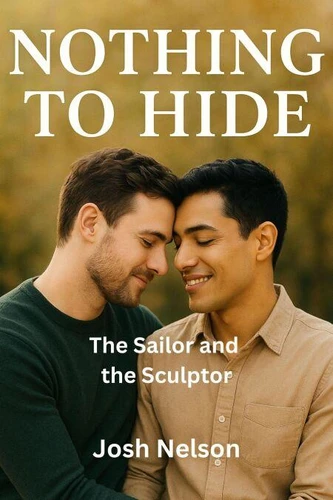
The Sailor and the Sculptor is a quiet, emotionally layered gay romance about two men shaped by opposing instincts-one who lives by departure, and one who survives through permanence. Morgan is a sailor who has spent his life moving from port to port, convinced that staying leads only to attachment, and attachment inevitably leads to loss. Evan is a sculptor in a small coastal town, a man who builds his world from stone-controlled, deliberate, and deeply guarded.
His art is not just craft, but memory carved into form, shaped by grief he never fully speaks aloud. When Morgan arrives in Evan's town after taking dock work, their first encounters are sharp, restrained, and full of unspoken tension. What begins as brief interactions-arguments about permanence, philosophy, and control-slowly becomes something harder to ignore. Proximity forces them into shared space: repairing docks, working in the studio, surviving storms, and confronting the emotional structures they both use to avoid being hurt.
As a storm nearly destroys Evan's unfinished public sculpture, the fragile boundaries between them begin to crack. Morgan stays longer than he intended. Evan stops pretending he does not care. And what neither of them expected begins to form in the space between silence and honesty. Morgan, who has always left before he could be left, begins to question whether movement is freedom or avoidance. Evan, who builds permanence in stone, begins to realize that nothing truly stays unchanged-not even grief, not even control, not even him.
Set against a quiet coastal backdrop, The Sailor and the Sculptor is a story about emotional resistance, vulnerability, and the slow, uncertain act of staying. It explores what it means to be seen without armor, and whether two people shaped by loss can build something that does not depend on escape or permanence-but on choice. This is not a story of grand declarations. It is a story of presence. Of silence shared.
Of change that does not destroy, but transforms.
The Sailor and the Sculptor is a quiet, emotionally layered gay romance about two men shaped by opposing instincts-one who lives by departure, and one who survives through permanence. Morgan is a sailor who has spent his life moving from port to port, convinced that staying leads only to attachment, and attachment inevitably leads to loss. Evan is a sculptor in a small coastal town, a man who builds his world from stone-controlled, deliberate, and deeply guarded.
His art is not just craft, but memory carved into form, shaped by grief he never fully speaks aloud. When Morgan arrives in Evan's town after taking dock work, their first encounters are sharp, restrained, and full of unspoken tension. What begins as brief interactions-arguments about permanence, philosophy, and control-slowly becomes something harder to ignore. Proximity forces them into shared space: repairing docks, working in the studio, surviving storms, and confronting the emotional structures they both use to avoid being hurt.
As a storm nearly destroys Evan's unfinished public sculpture, the fragile boundaries between them begin to crack. Morgan stays longer than he intended. Evan stops pretending he does not care. And what neither of them expected begins to form in the space between silence and honesty. Morgan, who has always left before he could be left, begins to question whether movement is freedom or avoidance. Evan, who builds permanence in stone, begins to realize that nothing truly stays unchanged-not even grief, not even control, not even him.
Set against a quiet coastal backdrop, The Sailor and the Sculptor is a story about emotional resistance, vulnerability, and the slow, uncertain act of staying. It explores what it means to be seen without armor, and whether two people shaped by loss can build something that does not depend on escape or permanence-but on choice. This is not a story of grand declarations. It is a story of presence. Of silence shared.
Of change that does not destroy, but transforms.


 , qui est-ce ?