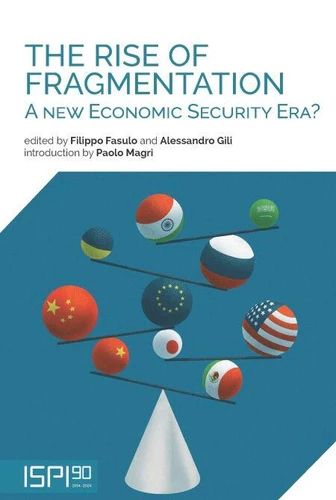
The Rise of Fragmentation. A New Economic Security Era?
Par : ,Formats :
Disponible dans votre compte client Decitre ou Furet du Nord dès validation de votre commande. Le format ePub est :
- Compatible avec une lecture sur My Vivlio (smartphone, tablette, ordinateur)
- Compatible avec une lecture sur liseuses Vivlio
- Pour les liseuses autres que Vivlio, vous devez utiliser le logiciel Adobe Digital Edition. Non compatible avec la lecture sur les liseuses Kindle, Remarkable et Sony
 , qui est-ce ?
Notre partenaire de plateforme de lecture numérique où vous retrouverez l'ensemble de vos ebooks gratuitement
Pour en savoir plus sur nos ebooks, consultez notre aide en ligne ici
C'est si simple ! Lisez votre ebook avec l'app Vivlio sur votre tablette, mobile ou ordinateur :

- Nombre de pages138
- FormatePub
- ISBN1256002863
- EAN9791256002863
- Date de parution31/01/2025
- Protection num.Digital Watermarking
- Taille1 Mo
- Infos supplémentairesepub
- ÉditeurLedizioni
Résumé
Multiple crises have shaken the foundations of the global economy, and the resulting instability has yet to recover. Instead, it has led to increasing fragmentation along political and ideological lines. The current geoeconomic order is increasingly defined by the use of advanced trade defense and economic security tools, such as tariffs, trade barriers, sanctions, and export restrictions, which have become more sophisticated.
Major economies are adapting to this new reality by shaping their own definitions of economic security, particularly to safeguard critical and high-tech sectors. The EU, the US, and China are each calibrating their economic security strategies, seeking a balance between openness and protection that maximizes their respective advantages. However, in this shifting international landscape, new actors are emerging with the potential to influence the global balance of power. What type of "new globalization" is emerging? Could economic security tools become the new normal in the global economy? What are the key economic security strategies adopted by the world's leading economies?
Major economies are adapting to this new reality by shaping their own definitions of economic security, particularly to safeguard critical and high-tech sectors. The EU, the US, and China are each calibrating their economic security strategies, seeking a balance between openness and protection that maximizes their respective advantages. However, in this shifting international landscape, new actors are emerging with the potential to influence the global balance of power. What type of "new globalization" is emerging? Could economic security tools become the new normal in the global economy? What are the key economic security strategies adopted by the world's leading economies?