SOLDES
Jusqu'à -70% sur une sélection d'articles*

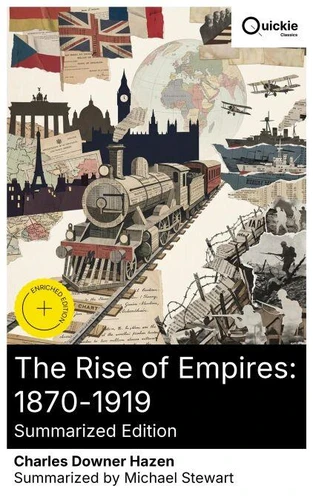
The Rise of Empires: 1870-1919 (Summarized Edition). Enriched edition. From the Franco-Prussian War to the Paris Peace Conference: Rivalries, Railways, and Empire on the Road to World War I
Par : ,Formats :
Disponible dans votre compte client Decitre ou Furet du Nord dès validation de votre commande. Le format ePub est :
- Compatible avec une lecture sur My Vivlio (smartphone, tablette, ordinateur)
- Compatible avec une lecture sur liseuses Vivlio
- Pour les liseuses autres que Vivlio, vous devez utiliser le logiciel Adobe Digital Edition. Non compatible avec la lecture sur les liseuses Kindle, Remarkable et Sony
 , qui est-ce ?
Notre partenaire de plateforme de lecture numérique où vous retrouverez l'ensemble de vos ebooks gratuitement
Pour en savoir plus sur nos ebooks, consultez notre aide en ligne ici
C'est si simple ! Lisez votre ebook avec l'app Vivlio sur votre tablette, mobile ou ordinateur :

- Nombre de pages106
- FormatePub
- ISBN859-65--4787742-4
- EAN8596547877424
- Date de parution10/01/2026
- Protection num.Digital Watermarking
- Taille888 Ko
- Infos supplémentairesepub
- ÉditeurQUICKIE CLASSICS
Résumé
Covering the half-century from the Franco-Prussian War to the Paris Peace Conference, The Rise of Empires: 1870-1919 charts how national consolidation, industrial capitalism, and imperial rivalry reordered world power. Hazen narrates Germany's ascent, Britain's recalibrations, the partition of Africa and Asia, and the alliance system that made local crises continental. With a lucid, panoramic style grounded in diplomatic and economic history, he links railways, tariffs, and mass politics to the arms race and the catastrophe of 1914-18.
Charles Downer Hazen, an American historian of modern Europe, wrote amid the immediate aftermath of the Great War, distilling years of university teaching into a coherent explanation of causation rather than blame. Trained in diplomatic and institutional history and widely read in memoirs and official papers, he favored clear argument over spectacle, synthesizing scholarship for students and informed publics shaped by Progressive-era expectations of evidence and civic instruction.
Recommended to readers of diplomatic, imperial, and military history, this volume offers orientation without oversimplification and context without polemic. Its disciplined synthesis makes it an ideal companion for courses on modern Europe and for general readers seeking to understand how the long prewar decades culminated in global conflict and a new, uneasy international order. Quickie Classics summarizes timeless works with precision, preserving the author's voice and keeping the prose clear, fast, and readable-distilled, never diluted.
Enriched Edition extras: Introduction · Synopsis · Historical Context · Brief Analysis · 4 Reflection Q&As · Editorial Footnotes.
Charles Downer Hazen, an American historian of modern Europe, wrote amid the immediate aftermath of the Great War, distilling years of university teaching into a coherent explanation of causation rather than blame. Trained in diplomatic and institutional history and widely read in memoirs and official papers, he favored clear argument over spectacle, synthesizing scholarship for students and informed publics shaped by Progressive-era expectations of evidence and civic instruction.
Recommended to readers of diplomatic, imperial, and military history, this volume offers orientation without oversimplification and context without polemic. Its disciplined synthesis makes it an ideal companion for courses on modern Europe and for general readers seeking to understand how the long prewar decades culminated in global conflict and a new, uneasy international order. Quickie Classics summarizes timeless works with precision, preserving the author's voice and keeping the prose clear, fast, and readable-distilled, never diluted.
Enriched Edition extras: Introduction · Synopsis · Historical Context · Brief Analysis · 4 Reflection Q&As · Editorial Footnotes.
A propos de Charles Downer Hazen












1,99 €