SOLDES
Jusqu'à -70% sur une sélection d'articles*

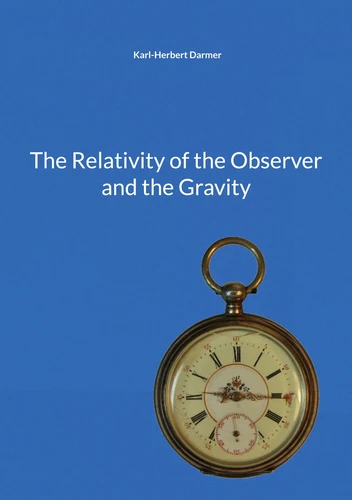
The Relativity of the Observer and the Gravity
Par :Formats :
Disponible dans votre compte client Decitre ou Furet du Nord dès validation de votre commande. Le format PDF est :
- Compatible avec une lecture sur My Vivlio (smartphone, tablette, ordinateur)
- Compatible avec une lecture sur liseuses Vivlio
- Pour les liseuses autres que Vivlio, vous devez utiliser le logiciel Adobe Digital Edition. Non compatible avec la lecture sur les liseuses Kindle, Remarkable et Sony
 , qui est-ce ?
Notre partenaire de plateforme de lecture numérique où vous retrouverez l'ensemble de vos ebooks gratuitement
Pour en savoir plus sur nos ebooks, consultez notre aide en ligne ici
C'est si simple ! Lisez votre ebook avec l'app Vivlio sur votre tablette, mobile ou ordinateur :

- Nombre de pages128
- FormatPDF
- ISBN978-3-7562-6181-9
- EAN9783756261819
- Date de parution29/04/2022
- Protection num.Digital Watermarking
- Taille4 Mo
- Infos supplémentairespdf
- ÉditeurBooks on Demand
Résumé
The book describes in a very unconventional way the role of man as an observer in the universe that surrounds us. Many physical phenomena are described from an unfamiliar point of view. These include wave-particle duality of light, the speed of light, why are space and time relative, what does reality mean, what are reference systems, what do the Lorentz transformations link, without necessarily having to deal with mathematics.
The book should be of interest to anyone who considers himself an observer. It doesn't matter what he wants to watch. It is about the principles that arise when observing. What can generally be regarded as secured. Unfortunately, that's not much, because in order to draw conclusions from what has been secured, you have to make assumptions. These do not have to be correct and results that are logically incompatible with these assumptions are excluded from the outset by these assumptions.
If one is willing to break away from some of these assumptions, possible solutions could arise for puzzling observations in the sky.
The book should be of interest to anyone who considers himself an observer. It doesn't matter what he wants to watch. It is about the principles that arise when observing. What can generally be regarded as secured. Unfortunately, that's not much, because in order to draw conclusions from what has been secured, you have to make assumptions. These do not have to be correct and results that are logically incompatible with these assumptions are excluded from the outset by these assumptions.
If one is willing to break away from some of these assumptions, possible solutions could arise for puzzling observations in the sky.