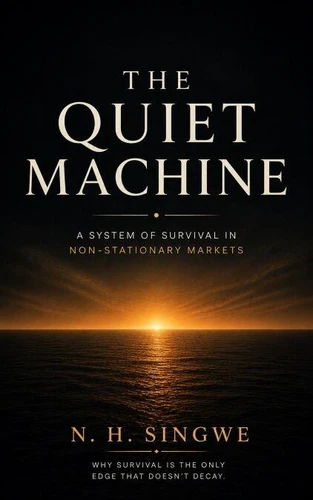
Most traders don't fail because their strategy is wrong. They fail because their architecture was never built to survive the strategy being right only some of the time. The Quiet Machine began as a question about trading software. It ended as a complete operating philosophy for anyone trying to build something that lasts in markets engineered to punish certainty. After eleven weeks watching a statistically sound system bleed - one validated across three currency pairs and twelve hundred trades - author N H Singwe stopped asking how to build a winning strategy and started asking a harder question: how do you build something that survives long enough for statistical reality to surface?What followed was an extended dialogue that became this book: a rigorous, unflinching framework for systematic traders who have moved past indicator-chasing and are ready to confront the real binding constraint on their profitability - not their signal, not their software, but the architecture around both.
Inside, you'll learn:? Why "edge" is not what most traders think it is - and a definition that doesn't get softer under pressure? Why complexity migrates upward, and why retail traders chase it in exactly the wrong layer of their system? How volatility targeting functions as cognitive bandwidth management, not just risk control? Why drawdowns are structural weather, not emergencies - and how to build a system that treats them that way? The mathematics of not blowing up, explained without unnecessary jargon? Why the operator - not the model - is the primary source of systemic risk, and what to build around that fact This is not a book of indicators, entry signals, or promises of an edge that never decays.
It is a field manual for durability: for traders, quant-curious retail operators, and prop firm candidates who already know the market doesn't reward being right. It rewards still being there. The edge is not found. It is maintained. This is the book about what survives the gap.
Most traders don't fail because their strategy is wrong. They fail because their architecture was never built to survive the strategy being right only some of the time. The Quiet Machine began as a question about trading software. It ended as a complete operating philosophy for anyone trying to build something that lasts in markets engineered to punish certainty. After eleven weeks watching a statistically sound system bleed - one validated across three currency pairs and twelve hundred trades - author N H Singwe stopped asking how to build a winning strategy and started asking a harder question: how do you build something that survives long enough for statistical reality to surface?What followed was an extended dialogue that became this book: a rigorous, unflinching framework for systematic traders who have moved past indicator-chasing and are ready to confront the real binding constraint on their profitability - not their signal, not their software, but the architecture around both.
Inside, you'll learn:? Why "edge" is not what most traders think it is - and a definition that doesn't get softer under pressure? Why complexity migrates upward, and why retail traders chase it in exactly the wrong layer of their system? How volatility targeting functions as cognitive bandwidth management, not just risk control? Why drawdowns are structural weather, not emergencies - and how to build a system that treats them that way? The mathematics of not blowing up, explained without unnecessary jargon? Why the operator - not the model - is the primary source of systemic risk, and what to build around that fact This is not a book of indicators, entry signals, or promises of an edge that never decays.
It is a field manual for durability: for traders, quant-curious retail operators, and prop firm candidates who already know the market doesn't reward being right. It rewards still being there. The edge is not found. It is maintained. This is the book about what survives the gap.

 , qui est-ce ?
