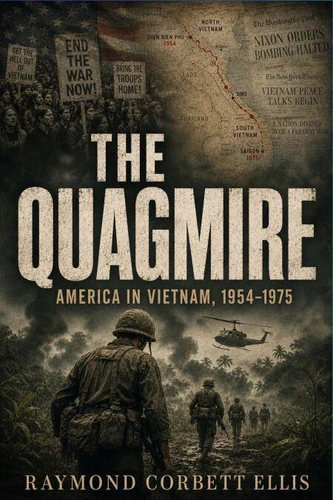
The complete narrative history of the Vietnam War - Ho Chi Minh, the Tet Offensive, the draft, My Lai, the fall of Saigon, and America's longest war, 1954-1975.
On the morning of March 16, 1968, soldiers of Charlie Company entered a Vietnamese hamlet called My Lai 4 with orders to engage a Viet Cong stronghold. They found unarmed civilians-elderly men, women, children. By midday they had killed up to 504 of them.
One officer, Warrant Officer Hugh Thompson Jr., landed his helicopter between American soldiers and fleeing villagers and threatened to fire on the Americans if they did not stop. The massacre was covered up for more than a year. When journalist Seymour Hersh revealed it in November 1969, the image of what the war required permanently changed.
Raymond Corbett Ellis traces the full arc of the Vietnam War across twenty-four chapters-from Ho Chi Minh's 1919 petition to Woodrow Wilson at the Paris Peace Conference (ignored) through the last helicopter leaving a Saigon rooftop on April 29, 1975.
This is the story of how a Vietnamese revolutionary nationalist movement that American policymakers consistently misread as a Soviet instrument outlasted the most powerful military force in human history, at a cost of 58, 220 American names on a black wall and between one and three million Vietnamese dead.
Inside this Vietnam War history:
Ho Chi Minh and the roots of resistance - a man who quoted the Declaration of Independence in Hanoi's Ba Dinh Square in 1945 while American OSS officers worked alongside his forces, and why the relationship that might have been never was (Chapter 1)
The Gulf of Tonkin deception - the incident, the resolution, and how a disputed event became the blank check for escalation (Chapter 5)
The draft's class inequity - the Selective Service system conscripted more than 2.2 million men while college deferments, National Guard slots, and political connections shielded others; Black soldiers accounted for more than 20 percent of combat deaths in 1965-66 while representing 11 percent of the population (Chapter 13)
Tet and the credibility gap - a military operation the North Vietnamese considered a failure became the political turning point that destroyed Lyndon Johnson's presidency (Chapter 8)
The ground war's human cost - triple-canopy jungle, booby traps, the rotation system that disrupted unit cohesion, heroin used by an estimated 30 percent of American soldiers by 1971, and the fragging of officers (Chapter 14)
The lessons not learned - how the institutional culture of optimistic reporting, body-count metrics, and political deception that produced Vietnam reappeared in Iraq and Afghanistan (Chapter 24)
The Vietnam War was America's longest war and its most consequential defeat - not because the military failed to fight, but because the political and strategic framework was wrong from the beginning.
Ellis delivers the full Vietnam War history: the decision-makers who escalated, the soldiers who fought, the Vietnamese who endured, and the country that has still not finished reckoning with what it did.
For readers of Neil Sheehan's A BRIGHT SHINING LIE and David Halberstam's THE BEST AND THE BRIGHTEST.
The complete narrative history of the Vietnam War - Ho Chi Minh, the Tet Offensive, the draft, My Lai, the fall of Saigon, and America's longest war, 1954-1975.
On the morning of March 16, 1968, soldiers of Charlie Company entered a Vietnamese hamlet called My Lai 4 with orders to engage a Viet Cong stronghold. They found unarmed civilians-elderly men, women, children. By midday they had killed up to 504 of them.
One officer, Warrant Officer Hugh Thompson Jr., landed his helicopter between American soldiers and fleeing villagers and threatened to fire on the Americans if they did not stop. The massacre was covered up for more than a year. When journalist Seymour Hersh revealed it in November 1969, the image of what the war required permanently changed.
Raymond Corbett Ellis traces the full arc of the Vietnam War across twenty-four chapters-from Ho Chi Minh's 1919 petition to Woodrow Wilson at the Paris Peace Conference (ignored) through the last helicopter leaving a Saigon rooftop on April 29, 1975.
This is the story of how a Vietnamese revolutionary nationalist movement that American policymakers consistently misread as a Soviet instrument outlasted the most powerful military force in human history, at a cost of 58, 220 American names on a black wall and between one and three million Vietnamese dead.
Inside this Vietnam War history:
Ho Chi Minh and the roots of resistance - a man who quoted the Declaration of Independence in Hanoi's Ba Dinh Square in 1945 while American OSS officers worked alongside his forces, and why the relationship that might have been never was (Chapter 1)
The Gulf of Tonkin deception - the incident, the resolution, and how a disputed event became the blank check for escalation (Chapter 5)
The draft's class inequity - the Selective Service system conscripted more than 2.2 million men while college deferments, National Guard slots, and political connections shielded others; Black soldiers accounted for more than 20 percent of combat deaths in 1965-66 while representing 11 percent of the population (Chapter 13)
Tet and the credibility gap - a military operation the North Vietnamese considered a failure became the political turning point that destroyed Lyndon Johnson's presidency (Chapter 8)
The ground war's human cost - triple-canopy jungle, booby traps, the rotation system that disrupted unit cohesion, heroin used by an estimated 30 percent of American soldiers by 1971, and the fragging of officers (Chapter 14)
The lessons not learned - how the institutional culture of optimistic reporting, body-count metrics, and political deception that produced Vietnam reappeared in Iraq and Afghanistan (Chapter 24)
The Vietnam War was America's longest war and its most consequential defeat - not because the military failed to fight, but because the political and strategic framework was wrong from the beginning.
Ellis delivers the full Vietnam War history: the decision-makers who escalated, the soldiers who fought, the Vietnamese who endured, and the country that has still not finished reckoning with what it did.
For readers of Neil Sheehan's A BRIGHT SHINING LIE and David Halberstam's THE BEST AND THE BRIGHTEST.

 , qui est-ce ?
