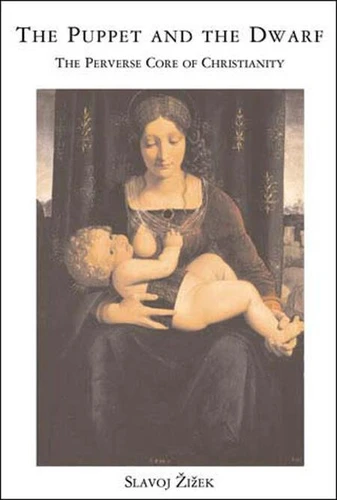
The Puppet and the Dwarf. The Perverse Core of Christianity
Par :Formats :
Disponible dans votre compte client Decitre ou Furet du Nord dès validation de votre commande. Le format ePub protégé est :
- Compatible avec une lecture sur My Vivlio (smartphone, tablette, ordinateur)
- Compatible avec une lecture sur liseuses Vivlio
- Pour les liseuses autres que Vivlio, vous devez utiliser le logiciel Adobe Digital Edition. Non compatible avec la lecture sur les liseuses Kindle, Remarkable et Sony
- Non compatible avec un achat hors France métropolitaine
 , qui est-ce ?
Notre partenaire de plateforme de lecture numérique où vous retrouverez l'ensemble de vos ebooks gratuitement
Pour en savoir plus sur nos ebooks, consultez notre aide en ligne ici
C'est si simple ! Lisez votre ebook avec l'app Vivlio sur votre tablette, mobile ou ordinateur :

- Nombre de pages196
- FormatePub
- ISBN0-262-26130-8
- EAN9780262261302
- Date de parution29/08/2003
- Protection num.Adobe DRM
- Taille300 Ko
- Infos supplémentairesepub
- ÉditeurThe MIT Press
Résumé
One of our most daring intellectuals offers a Lacanian interpretation of religion, finding that early Christianity was the first revolutionary collective. Slavoj Zizek has been called "an academic rock star" and "the wild man of theory"; his writing mixes astonishing erudition and references to pop culture in order to dissect current intellectual pieties. In The Puppet and the Dwarf he offers a close reading of today's religious constellation from the viewpoint of Lacanian psychoanalysis.
He critically confronts both predominant versions of today's spirituality-New Age gnosticism and deconstructionist-Levinasian Judaism-and then tries to redeem the "materialist" kernel of Christianity. His reading of Christianity is explicitly political, discerning in the Pauline community of believers the first version of a revolutionary collective. Since today even advocates of Enlightenment like Jurgen Habermas acknowledge that a religious vision is needed to ground our ethical and political stance in a "postsecular" age, this book-with a stance that is clearly materialist and at the same time indebted to the core of the Christian legacy-is certain to stir controversy.
He critically confronts both predominant versions of today's spirituality-New Age gnosticism and deconstructionist-Levinasian Judaism-and then tries to redeem the "materialist" kernel of Christianity. His reading of Christianity is explicitly political, discerning in the Pauline community of believers the first version of a revolutionary collective. Since today even advocates of Enlightenment like Jurgen Habermas acknowledge that a religious vision is needed to ground our ethical and political stance in a "postsecular" age, this book-with a stance that is clearly materialist and at the same time indebted to the core of the Christian legacy-is certain to stir controversy.