SOLDES
Jusqu'à -70% sur une sélection d'articles*

Nouveauté
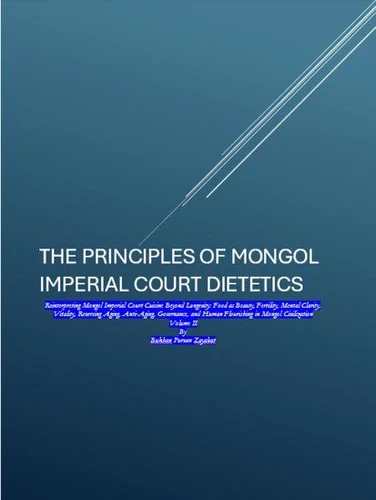
THE PRINCIPLES OF MONGOL IMPERIAL COURT DIETETICS: Reinterpreting Mongol Imperial Court Cuisine Beyond Longevity. THE PRINCIPLES OF MONGOL IMPERIAL COURT DIETETICS, #2
Par :Formats :
Disponible dans votre compte client Decitre ou Furet du Nord dès validation de votre commande. Le format ePub est :
- Compatible avec une lecture sur My Vivlio (smartphone, tablette, ordinateur)
- Compatible avec une lecture sur liseuses Vivlio
- Pour les liseuses autres que Vivlio, vous devez utiliser le logiciel Adobe Digital Edition. Non compatible avec la lecture sur les liseuses Kindle, Remarkable et Sony
 , qui est-ce ?
Notre partenaire de plateforme de lecture numérique où vous retrouverez l'ensemble de vos ebooks gratuitement
Pour en savoir plus sur nos ebooks, consultez notre aide en ligne ici
C'est si simple ! Lisez votre ebook avec l'app Vivlio sur votre tablette, mobile ou ordinateur :

- FormatePub
- ISBN8235413146
- EAN9798235413146
- Date de parution13/06/2026
- Protection num.pas de protection
- Infos supplémentairesepub
- ÉditeurIoakim Ioakim
Résumé
The Mongol World as the WorldGilles Deleuze taught us to see the nomad not as a wanderer without order, but as a creator of movement, relation, force, and becoming. In this sense, the nomad creates history before the sedentary world writes it. The sedentary scholar often records history from the viewpoint of walls, capitals, archives, borders, taxation, and fixed institutions. But the Mongol world was not born from walls.
It was born from movement, alliance, intelligence, logistics, memory, dietetics, diplomacy, military geometry, and the ability to gather many peoples into one strategic horizon. This book begins with a warning: if Mongol imperial court cuisine is read only through sedentary categories, it will be misunderstood. It will be reduced to exotic food, palace luxury, meat consumption, or longevity technique.
But the Mongol imperial court was not merely a palace. It was an imperial system of governance, medicine, logistics, ceremony, scholarship, translation, nutrition, and world-order thinking. Food belonged to that system. The historical record and Mongol court traditions show a long imperial practice of gathering the highest minds of the age. In the Yuan world, Prime Minister Bolad (1240-1313) Chingsang is remembered as helping gather 500 to 600 of the world's leading minds to develop geostrategies, administrative strategies, cultural strategies, and long-range development strategies for the empire.
Whether every number is preserved with modern archival precision is less important than the structural fact: Mongol imperial governance depended on organized intelligence, not only conquest. When Bolad was sent to the Ilkhanate, he carried this imperial method westward. There, he mentored and influenced the Ilkhanate court's own organization of 500 to 600 world-class scholars, physicians, administrators, translators, historians, astronomers, artists, and strategists, working with the Ilkhanate executive body led by Rashid al-Din Hamadani.
Their purpose was not only to write history, but to design state knowledge, development strategy, diplomatic memory, medical culture, and imperial legitimacy. The Jami? al-Tawarikh was only one visible part of this larger knowledge system. This tradition continued in another form under Ligdan Khan (1588-1634), who gathered 500 to 600 top scholars, translators, philologists, and religious intellectuals to create dictionaries, organize translation methods, and translate the Buddhist classics for the spiritual sovereignty of the Mongols.
These were not narrow religious activities. They were civilizational acts of preservation, renewal, and sovereign self-definition. Therefore, Husekhui's (Hu Sihui's) Principles of Dietetics (Yinshan Zhengyao) should be read within this wider Mongol imperial tradition. It was not only a cookbook and not only a medical text. It was part of the Mongol art of governing life: food as beauty, fertility, clarity, vitality, anti-aging, discipline, statecraft, and human flourishing.
In this sense, Mongol imperial court dietetics was not a minor culinary subject. It was one expression of the Mongol world as the world: a nomadic imperial civilization that transformed food into a technology of life, power, and becoming.
It was born from movement, alliance, intelligence, logistics, memory, dietetics, diplomacy, military geometry, and the ability to gather many peoples into one strategic horizon. This book begins with a warning: if Mongol imperial court cuisine is read only through sedentary categories, it will be misunderstood. It will be reduced to exotic food, palace luxury, meat consumption, or longevity technique.
But the Mongol imperial court was not merely a palace. It was an imperial system of governance, medicine, logistics, ceremony, scholarship, translation, nutrition, and world-order thinking. Food belonged to that system. The historical record and Mongol court traditions show a long imperial practice of gathering the highest minds of the age. In the Yuan world, Prime Minister Bolad (1240-1313) Chingsang is remembered as helping gather 500 to 600 of the world's leading minds to develop geostrategies, administrative strategies, cultural strategies, and long-range development strategies for the empire.
Whether every number is preserved with modern archival precision is less important than the structural fact: Mongol imperial governance depended on organized intelligence, not only conquest. When Bolad was sent to the Ilkhanate, he carried this imperial method westward. There, he mentored and influenced the Ilkhanate court's own organization of 500 to 600 world-class scholars, physicians, administrators, translators, historians, astronomers, artists, and strategists, working with the Ilkhanate executive body led by Rashid al-Din Hamadani.
Their purpose was not only to write history, but to design state knowledge, development strategy, diplomatic memory, medical culture, and imperial legitimacy. The Jami? al-Tawarikh was only one visible part of this larger knowledge system. This tradition continued in another form under Ligdan Khan (1588-1634), who gathered 500 to 600 top scholars, translators, philologists, and religious intellectuals to create dictionaries, organize translation methods, and translate the Buddhist classics for the spiritual sovereignty of the Mongols.
These were not narrow religious activities. They were civilizational acts of preservation, renewal, and sovereign self-definition. Therefore, Husekhui's (Hu Sihui's) Principles of Dietetics (Yinshan Zhengyao) should be read within this wider Mongol imperial tradition. It was not only a cookbook and not only a medical text. It was part of the Mongol art of governing life: food as beauty, fertility, clarity, vitality, anti-aging, discipline, statecraft, and human flourishing.
In this sense, Mongol imperial court dietetics was not a minor culinary subject. It was one expression of the Mongol world as the world: a nomadic imperial civilization that transformed food into a technology of life, power, and becoming.