
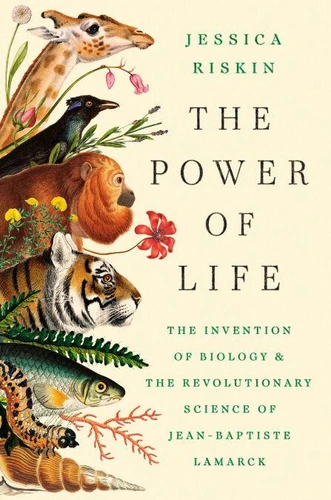
The Power of Life. The Invention of Biology and the Revolutionary Science of Jean-Baptiste Lamarck
Par :Formats :
Disponible dans votre compte client Decitre ou Furet du Nord dès validation de votre commande. Le format ePub protégé est :
- Compatible avec une lecture sur My Vivlio (smartphone, tablette, ordinateur)
- Compatible avec une lecture sur liseuses Vivlio
- Pour les liseuses autres que Vivlio, vous devez utiliser le logiciel Adobe Digital Edition. Non compatible avec la lecture sur les liseuses Kindle, Remarkable et Sony
- Non compatible avec un achat hors France métropolitaine
 , qui est-ce ?
Notre partenaire de plateforme de lecture numérique où vous retrouverez l'ensemble de vos ebooks gratuitement
Pour en savoir plus sur nos ebooks, consultez notre aide en ligne ici
C'est si simple ! Lisez votre ebook avec l'app Vivlio sur votre tablette, mobile ou ordinateur :

- Nombre de pages496
- FormatePub
- ISBN978-0-593-85258-3
- EAN9780593852583
- Date de parution24/03/2026
- Protection num.Adobe DRM
- Taille42 Mo
- Infos supplémentairesepub
- ÉditeurRiverhead Books
Résumé
A NEW YORKER BEST BOOK OF 2026"A truly remarkable achievement." -Jill Lepore"A gorgeous story of human nature and animal behavior-and of the way science itself evolves." -Dava SobelThe tumultuous life and radical science of a revolutionary thinker, and the history of an idea that changed the worldIn the early nineteenth century, the French naturalist Jean-Baptiste Lamarck proposed the first evolutionary theory of life and, with it, a new science: biology.
Yet for centuries, evolutionary theorists have endeavored to discredit Lamarck and his theory of self-transforming organisms, rejecting the idea that animals play an active role in shaping their own evolution. In his lifetime, he was mocked by his adversaries and personally insulted by Napoleon. In this virtuosic melding of biography, history, politics, and science, Jessica Riskin sets out to correct the record.
Riskin tells the story of Lamarck's life and work as an intense struggle between rival forces to answer questions that remain foundational to our modern worldview: What is a living being, and what is science?New findings suggest Lamarck's basic claim was, in many ways, right, and a reconsideration of his life and work is long overdue. Denying the agency of living beings has informed two centuries of eugenic policies and environmental destruction, allowing people to regard the living world as so much raw material to shape and exploit for economic, industrial, and imperial gain.
Deeply researched, strikingly original, and beautifully written, The Power of Life shines a much-needed light on an underappreciated biologist whose radical ideas offered a more inclusive, collaborative, and enlightened approach to science.
Yet for centuries, evolutionary theorists have endeavored to discredit Lamarck and his theory of self-transforming organisms, rejecting the idea that animals play an active role in shaping their own evolution. In his lifetime, he was mocked by his adversaries and personally insulted by Napoleon. In this virtuosic melding of biography, history, politics, and science, Jessica Riskin sets out to correct the record.
Riskin tells the story of Lamarck's life and work as an intense struggle between rival forces to answer questions that remain foundational to our modern worldview: What is a living being, and what is science?New findings suggest Lamarck's basic claim was, in many ways, right, and a reconsideration of his life and work is long overdue. Denying the agency of living beings has informed two centuries of eugenic policies and environmental destruction, allowing people to regard the living world as so much raw material to shape and exploit for economic, industrial, and imperial gain.
Deeply researched, strikingly original, and beautifully written, The Power of Life shines a much-needed light on an underappreciated biologist whose radical ideas offered a more inclusive, collaborative, and enlightened approach to science.