
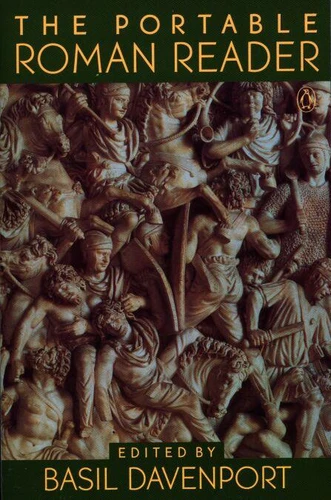
The Portable Roman Reader
Par : ,Formats :
Disponible dans votre compte client Decitre ou Furet du Nord dès validation de votre commande. Le format ePub protégé est :
- Compatible avec une lecture sur My Vivlio (smartphone, tablette, ordinateur)
- Compatible avec une lecture sur liseuses Vivlio
- Pour les liseuses autres que Vivlio, vous devez utiliser le logiciel Adobe Digital Edition. Non compatible avec la lecture sur les liseuses Kindle, Remarkable et Sony
- Non compatible avec un achat hors France métropolitaine
 , qui est-ce ?
Notre partenaire de plateforme de lecture numérique où vous retrouverez l'ensemble de vos ebooks gratuitement
Pour en savoir plus sur nos ebooks, consultez notre aide en ligne ici
C'est si simple ! Lisez votre ebook avec l'app Vivlio sur votre tablette, mobile ou ordinateur :

- Nombre de pages672
- FormatePub
- ISBN1-101-17375-0
- EAN9781101173756
- Date de parution27/01/1977
- Protection num.Adobe DRM
- Taille623 Ko
- Infos supplémentairesepub
- ÉditeurPenguin Books
Résumé
The Romans conquered most of the known world and detailed their conquests in calm, unapologetic histories. They were a supremely urbane people who longed poetically for the farming life. Valuing toughness and practicality in all things, they turned the love poem into a cynical rebuke and wrote tragedies in which the unfathomable actions of gods gave way to the staggering cruelties of man. As the empire slid into decay, Tacitus pulled back the curtain on the perverse intrigues of the emperors, and a Roman-educated Christian named Augustine recounted his spiritual awakening in what may be the world's first psychological novel.
This collection presents the essential writings of the Romans in their finest English translations: the comedies of Terence and Plautus; the histories of Julius Caesar, Livy and Tacitus; the oratory of Cicero; poems by Catullus, Virgil, Horace, and Martial; the philosophy of Lucretius and Boëthius, along with the stylishly narrated and often ribald myths of Ovid and Apuleius.
This collection presents the essential writings of the Romans in their finest English translations: the comedies of Terence and Plautus; the histories of Julius Caesar, Livy and Tacitus; the oratory of Cicero; poems by Catullus, Virgil, Horace, and Martial; the philosophy of Lucretius and Boëthius, along with the stylishly narrated and often ribald myths of Ovid and Apuleius.
A propos de Various


Hello Darkness #23
E-book
5,88 €
Hello Darkness Vol. 5
E-book
19,61 €

13 little love stories
E-book
9,99 €
1,99 €

19,61 €


0,99 €
Hello Darkness #22
E-book
4,90 €

The Buddha Way
E-book
2,93 €
Stoic Secrets
E-book
2,93 €

3,49 €


4,49 €

Hello Darkness #21
E-book
5,88 €

Hello Body Horror #1
E-book
5,88 €

Lumberjanes Book Four
E-book
19,61 €