
Nouveauté
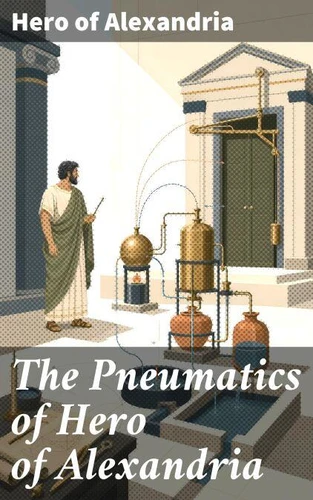
The Pneumatics of Hero of Alexandria. Hellenistic Treatise
Par : , ,Formats :
Disponible dans votre compte client Decitre ou Furet du Nord dès validation de votre commande. Le format ePub est :
- Compatible avec une lecture sur My Vivlio (smartphone, tablette, ordinateur)
- Compatible avec une lecture sur liseuses Vivlio
- Pour les liseuses autres que Vivlio, vous devez utiliser le logiciel Adobe Digital Edition. Non compatible avec la lecture sur les liseuses Kindle, Remarkable et Sony
 , qui est-ce ?
Notre partenaire de plateforme de lecture numérique où vous retrouverez l'ensemble de vos ebooks gratuitement
Pour en savoir plus sur nos ebooks, consultez notre aide en ligne ici
C'est si simple ! Lisez votre ebook avec l'app Vivlio sur votre tablette, mobile ou ordinateur :

- Nombre de pages130
- FormatePub
- ISBN859-65--4791574-4
- EAN8596547915744
- Date de parution29/06/2026
- Protection num.Digital Watermarking
- Taille8 Mo
- Infos supplémentairesepub
- ÉditeurGOOD PRESS
Résumé
The Pneumatics of Hero of Alexandria is a foundational treatise in ancient applied mechanics, assembling devices powered by air, steam, water, and pressure into a vivid demonstration of Hellenistic ingenuity. Written in a lucid, technical style, the work combines geometrical reasoning with practical description, explaining automata, temple mechanisms, fountains, and self-acting machines that blur the boundary between scientific inquiry and spectacle.
In the literary context of Alexandrian scientific prose, the book stands beside works of mechanics and mathematics that sought not merely to theorize but to render nature operational. Hero of Alexandria, active in Roman Egypt and associated with the intellectual traditions of Alexandria, was among antiquity's most inventive engineers and mathematical writers. His surviving corpus on mechanics, measurement, and automata reflects a culture shaped by the Museum's legacy, where geometry, craft knowledge, and experimentation converged.
The Pneumatics likely emerged from this environment of technical pedagogy and public wonder, revealing Hero's interest in translating abstract principles into reproducible mechanisms. This book is indispensable for readers interested in the history of science, engineering, and ancient technology. It rewards classicists, historians, and general readers alike with a rare view of a mind that understood invention as both rational demonstration and theatrical art.
In the literary context of Alexandrian scientific prose, the book stands beside works of mechanics and mathematics that sought not merely to theorize but to render nature operational. Hero of Alexandria, active in Roman Egypt and associated with the intellectual traditions of Alexandria, was among antiquity's most inventive engineers and mathematical writers. His surviving corpus on mechanics, measurement, and automata reflects a culture shaped by the Museum's legacy, where geometry, craft knowledge, and experimentation converged.
The Pneumatics likely emerged from this environment of technical pedagogy and public wonder, revealing Hero's interest in translating abstract principles into reproducible mechanisms. This book is indispensable for readers interested in the history of science, engineering, and ancient technology. It rewards classicists, historians, and general readers alike with a rare view of a mind that understood invention as both rational demonstration and theatrical art.