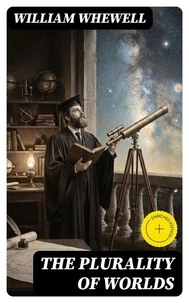
The Plurality of Worlds. Exploring the Cosmic Tapestry: A Journey into Extraterrestrial Life and the Mysteries of the Universe
Par :Formats :
Disponible dans votre compte client Decitre ou Furet du Nord dès validation de votre commande. Le format ePub est :
- Compatible avec une lecture sur My Vivlio (smartphone, tablette, ordinateur)
- Compatible avec une lecture sur liseuses Vivlio
- Pour les liseuses autres que Vivlio, vous devez utiliser le logiciel Adobe Digital Edition. Non compatible avec la lecture sur les liseuses Kindle, Remarkable et Sony
 , qui est-ce ?
Notre partenaire de plateforme de lecture numérique où vous retrouverez l'ensemble de vos ebooks gratuitement
Pour en savoir plus sur nos ebooks, consultez notre aide en ligne ici
C'est si simple ! Lisez votre ebook avec l'app Vivlio sur votre tablette, mobile ou ordinateur :

- Nombre de pages283
- FormatePub
- ISBN406-4-06-622083-9
- EAN4064066220839
- Date de parution10/12/2019
- Protection num.Digital Watermarking
- Taille591 Ko
- Infos supplémentairesepub
- ÉditeurGOOD PRESS
Résumé
In "The Plurality of Worlds, " William Whewell explores the profound implications of scientific inquiry on the perception of existence beyond Earth. Written in the early 19th century, this philosophical treatise delves into the burgeoning understanding of astronomy, intertwining Romantic ideals and emerging scientific thought. Whewell adopts a rigorous yet accessible prose style, inviting readers to consider the potential for extraterrestrial life while critically engaging with contemporary scientific discoveries.
The work reflects not only Whewell'Äôs engagement with the scientific advancements of his time but also his deep philosophical musings on the nature of the universe and humanity'Äôs place within it. William Whewell, a noted philosopher, historian of science, and polymath, served as the first Professor of Moral Philosophy at the University of Cambridge. His extensive background in both the sciences and philosophy informed his writings, as he sought to reconcile empirical evidence with metaphysical questions.
Whewell'Äôs multifaceted scholarship, which encompassed topics as diverse as geology and economics, allowed him to approach the question of the plurality of worlds with unique insight and authority, positioning him as a pivotal figure in the overlapping spheres of science and philosophy. "The Plurality of Worlds" is highly recommended for readers interested in the philosophical underpinnings of scientific discourse.
It invites both admiration and contemplation, bridging the gap between 19th-century thought and modern inquiry. This text remains a critical work for anyone seeking to understand the intersection of natural philosophy, ethics, and the ongoing exploration of our cosmos.
The work reflects not only Whewell'Äôs engagement with the scientific advancements of his time but also his deep philosophical musings on the nature of the universe and humanity'Äôs place within it. William Whewell, a noted philosopher, historian of science, and polymath, served as the first Professor of Moral Philosophy at the University of Cambridge. His extensive background in both the sciences and philosophy informed his writings, as he sought to reconcile empirical evidence with metaphysical questions.
Whewell'Äôs multifaceted scholarship, which encompassed topics as diverse as geology and economics, allowed him to approach the question of the plurality of worlds with unique insight and authority, positioning him as a pivotal figure in the overlapping spheres of science and philosophy. "The Plurality of Worlds" is highly recommended for readers interested in the philosophical underpinnings of scientific discourse.
It invites both admiration and contemplation, bridging the gap between 19th-century thought and modern inquiry. This text remains a critical work for anyone seeking to understand the intersection of natural philosophy, ethics, and the ongoing exploration of our cosmos.
A propos de William Whewell

1,99 €