
Michèle Fieux is professor of regional oceanography at the Ecole Nationale Supérieure des Techniques Avancées in Paris and member of the Marine Academy. Her lifework at the CNRS allowed her to live her passion through ocean research and by leading numerous oceanographic cruises. In the seventies, working with Henry Stommel had a great influence on her career.
Ferris Webster received a PhD in Geophysics at the Massachusetts Institute of Technology, then his career took him to the Woods Hole Oceanographic Institution, the US National Oceanic and Atmospheric Administration, and the College of Earth, Ocean, and Environment of the University of Delaware, where he is currently Professor Emeritus.
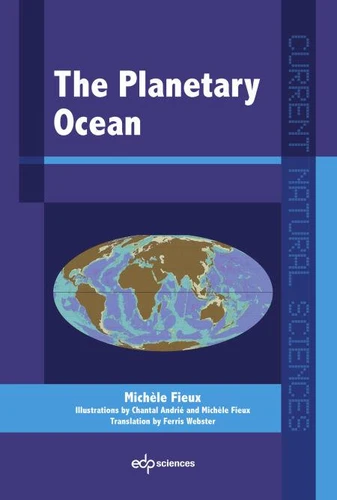
The Planetary Ocean
Par :Formats :
Disponible dans votre compte client Decitre ou Furet du Nord dès validation de votre commande. Le format PDF est :
- Compatible avec une lecture sur My Vivlio (smartphone, tablette, ordinateur)
- Compatible avec une lecture sur liseuses Vivlio
- Pour les liseuses autres que Vivlio, vous devez utiliser le logiciel Adobe Digital Edition. Non compatible avec la lecture sur les liseuses Kindle, Remarkable et Sony
 , qui est-ce ?
Notre partenaire de plateforme de lecture numérique où vous retrouverez l'ensemble de vos ebooks gratuitement
Pour en savoir plus sur nos ebooks, consultez notre aide en ligne ici
C'est si simple ! Lisez votre ebook avec l'app Vivlio sur votre tablette, mobile ou ordinateur :

- Nombre de pages580
- FormatPDF
- ISBN978-2-7598-2150-1
- EAN9782759821501
- Date de parution31/08/2017
- Protection num.Digital Watermarking
- Taille101 Mo
- Infos supplémentairespdf
- ÉditeurEDP Sciences
- TraducteurFerris Webster
Résumé
The description of ocean water masses is based on the study of their temperature, salinity, and density, virtual genetic imprints which provide identity and movement to water masses. Ocean characteristics and processes involved in exchanges with the atmosphere together with simple dynamic balances give an understanding of a large part of the vast oceanic system.
This book is enhanced with numerous colored illustrations.
It is a reference on regional oceanography updated with extensive results from the last twenty years. The presentation underscores the specificity of each ocean basin using a precise and global approach. Beginning with a brief historical context, it explains the interactions and the role of each ocean basin in the functioning of the planetary ocean. How do we recognize Antarctic Bottom Water in the middle of the Atlantic Ocean? What is the densest water mass? The warmest? Why doesn't dense water form in the largest ocean basin? What becomes of water that sinks in the Labrador Sea? Why does the ocean play such an important role in climate variations? .
Answers can be found in this book. Beyond a course in regional oceanography, the text is aimed at students in all fields of marine and environmental science as well as interested secondary school teachers. It also provides a guide to exploring the ocean planet that is comprehensible to any well-informed amateur eager to know the basics.
It is a reference on regional oceanography updated with extensive results from the last twenty years. The presentation underscores the specificity of each ocean basin using a precise and global approach. Beginning with a brief historical context, it explains the interactions and the role of each ocean basin in the functioning of the planetary ocean. How do we recognize Antarctic Bottom Water in the middle of the Atlantic Ocean? What is the densest water mass? The warmest? Why doesn't dense water form in the largest ocean basin? What becomes of water that sinks in the Labrador Sea? Why does the ocean play such an important role in climate variations? .
Answers can be found in this book. Beyond a course in regional oceanography, the text is aimed at students in all fields of marine and environmental science as well as interested secondary school teachers. It also provides a guide to exploring the ocean planet that is comprehensible to any well-informed amateur eager to know the basics.
A propos de Michèle Fieux
L'océan planétaire
2e édition
Grand Format
70,00 €
The Planetary Ocean
Grand Format
89,00 €