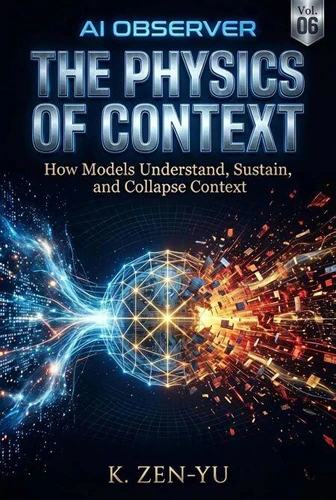
The Physics of Context. AI OBSERVER, #6
Par :Formats :
Disponible dans votre compte client Decitre ou Furet du Nord dès validation de votre commande. Le format ePub est :
- Compatible avec une lecture sur My Vivlio (smartphone, tablette, ordinateur)
- Compatible avec une lecture sur liseuses Vivlio
- Pour les liseuses autres que Vivlio, vous devez utiliser le logiciel Adobe Digital Edition. Non compatible avec la lecture sur les liseuses Kindle, Remarkable et Sony
 , qui est-ce ?
Notre partenaire de plateforme de lecture numérique où vous retrouverez l'ensemble de vos ebooks gratuitement
Pour en savoir plus sur nos ebooks, consultez notre aide en ligne ici
C'est si simple ! Lisez votre ebook avec l'app Vivlio sur votre tablette, mobile ou ordinateur :

- FormatePub
- ISBN8232838454
- EAN9798232838454
- Date de parution04/01/2026
- Protection num.pas de protection
- Infos supplémentairesepub
- ÉditeurDraft2Digital
Résumé
Context is not memory. It is a dynamic pressure field formed by accumulated semantics, attention bias, tonal direction, and structural tension. The Physics of Context examines how large language models construct, sustain, distort, and ultimately collapse context during extended generation. Rather than treating context as a static buffer or recall mechanism, this book reframes it as a continuously shifting vector pressure field-one that governs reasoning depth, stylistic stability, and behavioral boundaries.
This volume analyzes phenomena such as context collapse, mode shift, reasoning wear, and contextual fatigue, revealing why models drift toward shallow patterns under long-form load-and under what conditions deep reasoning can be restored. It introduces a structural framework explaining how semantic density, paragraph rhythm, and author-driven context jointly determine whether a model remains coherent or fragments into generic output.
Drawing from systematic observation of long-form AI behavior, this book demonstrates that stable reasoning is not a property of the model alone, but an emergent result of sustained contextual tension. When that tension weakens, reasoning layers reorganize. When it is reinforced, depth re-emerges-not as recovery, but as a second formation. The Physics of Context is written for readers seeking a precise, non-anthropomorphic understanding of how language models behave under pressure.
It offers a conceptual toolkit for researchers, technical writers, and system designers who need to work with model behavior rather than against it.
This volume analyzes phenomena such as context collapse, mode shift, reasoning wear, and contextual fatigue, revealing why models drift toward shallow patterns under long-form load-and under what conditions deep reasoning can be restored. It introduces a structural framework explaining how semantic density, paragraph rhythm, and author-driven context jointly determine whether a model remains coherent or fragments into generic output.
Drawing from systematic observation of long-form AI behavior, this book demonstrates that stable reasoning is not a property of the model alone, but an emergent result of sustained contextual tension. When that tension weakens, reasoning layers reorganize. When it is reinforced, depth re-emerges-not as recovery, but as a second formation. The Physics of Context is written for readers seeking a precise, non-anthropomorphic understanding of how language models behave under pressure.
It offers a conceptual toolkit for researchers, technical writers, and system designers who need to work with model behavior rather than against it.