
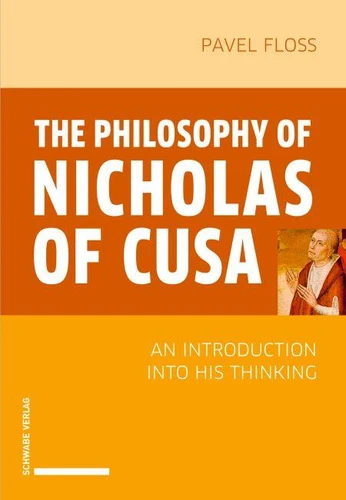
The Philosophy of Nicholas of Cusa. An Introduction into His Thinking.
Par :Formats :
Disponible dans votre compte client Decitre ou Furet du Nord dès validation de votre commande. Le format PDF est :
- Compatible avec une lecture sur My Vivlio (smartphone, tablette, ordinateur)
- Compatible avec une lecture sur liseuses Vivlio
- Pour les liseuses autres que Vivlio, vous devez utiliser le logiciel Adobe Digital Edition. Non compatible avec la lecture sur les liseuses Kindle, Remarkable et Sony
 , qui est-ce ?
Notre partenaire de plateforme de lecture numérique où vous retrouverez l'ensemble de vos ebooks gratuitement
Pour en savoir plus sur nos ebooks, consultez notre aide en ligne ici
C'est si simple ! Lisez votre ebook avec l'app Vivlio sur votre tablette, mobile ou ordinateur :

- Nombre de pages350
- FormatPDF
- ISBN978-3-7965-4195-7
- EAN9783796541957
- Date de parution13/05/2020
- Protection num.Digital Watermarking
- Taille4 Mo
- Infos supplémentairespdf
- ÉditeurSchwabe & Co
Résumé
Out of the broad variety of Cusanus' work, this book discusses six of his writings, careful not to isolate them from the whole of his work. It instead presents them against the maturation of Cusanus' thinking as it developed from his first sermons up to his shortest philosophical text De apice theoriae. The texts in question are De docta ignorantia, De coniecturis, Idiota de mente, De beryllo, Trialogus de possest and De apice theoriae.
In the search for God, or rather in Cusanus' lifetime eff orts to have his spirit touch the fi rst principle and the basis of all things, new perspectives on the world and man within would open up for Cusanus. Respecting this basic intention of Cusanus' thinking, the author primarily deals with Cusanus' ontotheological (metaphysical) claims and, in their context, turns his attention to the cosmological, or anthropologico-gnoseological opinions.
In the search for God, or rather in Cusanus' lifetime eff orts to have his spirit touch the fi rst principle and the basis of all things, new perspectives on the world and man within would open up for Cusanus. Respecting this basic intention of Cusanus' thinking, the author primarily deals with Cusanus' ontotheological (metaphysical) claims and, in their context, turns his attention to the cosmological, or anthropologico-gnoseological opinions.