SOLDES
Jusqu'à -70% sur une sélection d'articles*

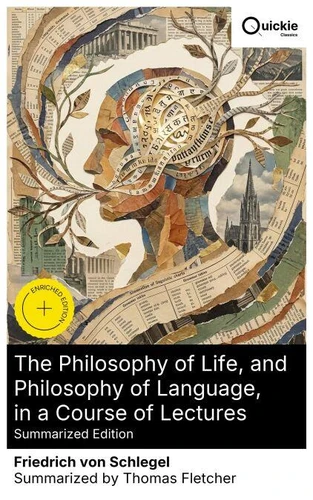
The Philosophy of Life, and Philosophy of Language, in a Course of Lectures (Summarized Edition). Enriched edition. Words as Life's Organ: Romantic Philology from Myth to Comparative Grammar
Par : , ,Formats :
Disponible dans votre compte client Decitre ou Furet du Nord dès validation de votre commande. Le format ePub est :
- Compatible avec une lecture sur My Vivlio (smartphone, tablette, ordinateur)
- Compatible avec une lecture sur liseuses Vivlio
- Pour les liseuses autres que Vivlio, vous devez utiliser le logiciel Adobe Digital Edition. Non compatible avec la lecture sur les liseuses Kindle, Remarkable et Sony
 , qui est-ce ?
Notre partenaire de plateforme de lecture numérique où vous retrouverez l'ensemble de vos ebooks gratuitement
Pour en savoir plus sur nos ebooks, consultez notre aide en ligne ici
C'est si simple ! Lisez votre ebook avec l'app Vivlio sur votre tablette, mobile ou ordinateur :

- Nombre de pages191
- FormatePub
- ISBN859-65--4787845-2
- EAN8596547878452
- Date de parution10/01/2026
- Protection num.Digital Watermarking
- Taille1 Mo
- Infos supplémentairesepub
- ÉditeurQUICKIE CLASSICS
Résumé
This capacious course of lectures binds a philosophy of life to a philosophy of language, claiming that vitality is the formative principle of nature, history, and art, and that speech is life's luminescent organ. Ranging from myth to etymology and comparative grammar, Schlegel traces how languages grow, differentiate, and embody national spirit while mediating thought. The lectures move with Romantic breadth-at once aphoristic and systematic-synthesizing philology and cultural history.
Set within late German Romanticism and conversing with Herder, Humboldt, and post-Kantian Naturphilosophie, the book proposes an organic alternative to mechanistic models of mind and society. Friedrich von Schlegel, cofounder of early Romanticism, was both critic and philologist; his study of Sanskrit and Indo-European roots, together with a turn to Catholic universality, oriented him toward historical development and unity in diversity.
In his later Vienna lectures he sought to reconcile speculative philosophy with empirical scholarship, fusing the salon wit and fragmentary daring of Jena with mature systematic ambition. For readers of philosophy, literary theory, theology, and linguistics, this book offers a generative map of ideas. It rewards anyone seeking to grasp how words shape worlds and how cultures live through their languages, an indispensable entry to Romantic thought's living legacy. Quickie Classics summarizes timeless works with precision, preserving the author's voice and keeping the prose clear, fast, and readable-distilled, never diluted.
Enriched Edition extras: Introduction · Synopsis · Historical Context · Brief Analysis · 4 Reflection Q&As · Editorial Footnotes.
Set within late German Romanticism and conversing with Herder, Humboldt, and post-Kantian Naturphilosophie, the book proposes an organic alternative to mechanistic models of mind and society. Friedrich von Schlegel, cofounder of early Romanticism, was both critic and philologist; his study of Sanskrit and Indo-European roots, together with a turn to Catholic universality, oriented him toward historical development and unity in diversity.
In his later Vienna lectures he sought to reconcile speculative philosophy with empirical scholarship, fusing the salon wit and fragmentary daring of Jena with mature systematic ambition. For readers of philosophy, literary theory, theology, and linguistics, this book offers a generative map of ideas. It rewards anyone seeking to grasp how words shape worlds and how cultures live through their languages, an indispensable entry to Romantic thought's living legacy. Quickie Classics summarizes timeless works with precision, preserving the author's voice and keeping the prose clear, fast, and readable-distilled, never diluted.
Enriched Edition extras: Introduction · Synopsis · Historical Context · Brief Analysis · 4 Reflection Q&As · Editorial Footnotes.
A propos de Friedrich von Schlegel


0,99 €

1,99 €
0,99 €