SOLDES
Jusqu'à -70% sur une sélection d'articles*

Nouveauté
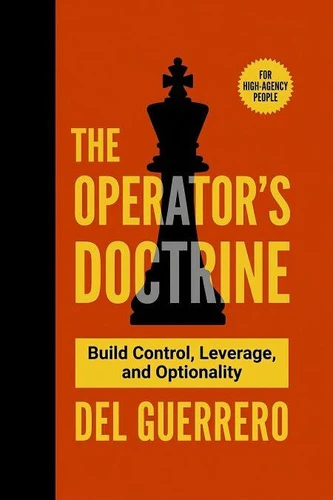
The Operator’s Doctrine: Build Control, Leverage, and Optionality
Par :Formats :
Disponible dans votre compte client Decitre ou Furet du Nord dès validation de votre commande. Le format ePub est :
- Compatible avec une lecture sur My Vivlio (smartphone, tablette, ordinateur)
- Compatible avec une lecture sur liseuses Vivlio
- Pour les liseuses autres que Vivlio, vous devez utiliser le logiciel Adobe Digital Edition. Non compatible avec la lecture sur les liseuses Kindle, Remarkable et Sony
 , qui est-ce ?
Notre partenaire de plateforme de lecture numérique où vous retrouverez l'ensemble de vos ebooks gratuitement
Pour en savoir plus sur nos ebooks, consultez notre aide en ligne ici
C'est si simple ! Lisez votre ebook avec l'app Vivlio sur votre tablette, mobile ou ordinateur :

- FormatePub
- ISBN8235299726
- EAN9798235299726
- Date de parution16/06/2026
- Protection num.pas de protection
- Infos supplémentairesepub
- ÉditeurIoakim Ioakim
Résumé
This book is a field-ready operating manual for the high-agency operator who refuses to be carried by default structures. It teaches how to read the architecture of any system - business, financial, personal, relational - identify the control surfaces that actually move outcomes, and redesign the structure instead of enduring it. The framework maps control across four layers: personal, relational, structural, and narrative.
It exposes the quiet traps of fragility points, dependency chains, and cognitive overload, and replaces them with deliberate design - low-load minds, exit-first strategies, asymmetric living, and parallel systems that keep options open under pressure. The operator is not trained to hustle more, but to compress decisions into rules, distribute cognitive load, and build systems that run without their constant presence.
The book blends strategic architecture with execution clarity - helping the reader distinguish control surfaces from noise, irreversible commitments from reversible experiments, and signaling from silent leverage. It positions the operator as someone who lets systems drift just enough to reveal their structure, then intervenes with precision, not panic. The appendices give the operator a field reference to return to repeatedly: a cheat sheet, decision filters, and a working glossary.
The book functions as a toolkit, not a one-time read. The tone is direct, unsentimental, and calibrated for the operator who wants structure, not hype, and clarity, not cheerleading.
It exposes the quiet traps of fragility points, dependency chains, and cognitive overload, and replaces them with deliberate design - low-load minds, exit-first strategies, asymmetric living, and parallel systems that keep options open under pressure. The operator is not trained to hustle more, but to compress decisions into rules, distribute cognitive load, and build systems that run without their constant presence.
The book blends strategic architecture with execution clarity - helping the reader distinguish control surfaces from noise, irreversible commitments from reversible experiments, and signaling from silent leverage. It positions the operator as someone who lets systems drift just enough to reveal their structure, then intervenes with precision, not panic. The appendices give the operator a field reference to return to repeatedly: a cheat sheet, decision filters, and a working glossary.
The book functions as a toolkit, not a one-time read. The tone is direct, unsentimental, and calibrated for the operator who wants structure, not hype, and clarity, not cheerleading.