SOLDES
Jusqu'à -70% sur une sélection d'articles*

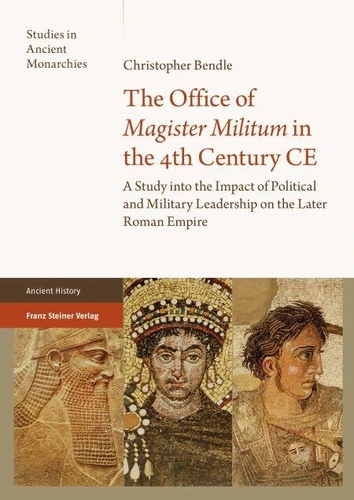
The Office of "Magister Militum" in the 4th Century CE. A Study into the Impact of Political and Military Leadership on the Later Roman Empire
Par :Formats :
Disponible dans votre compte client Decitre ou Furet du Nord dès validation de votre commande. Le format PDF est :
- Compatible avec une lecture sur My Vivlio (smartphone, tablette, ordinateur)
- Compatible avec une lecture sur liseuses Vivlio
- Pour les liseuses autres que Vivlio, vous devez utiliser le logiciel Adobe Digital Edition. Non compatible avec la lecture sur les liseuses Kindle, Remarkable et Sony
 , qui est-ce ?
Notre partenaire de plateforme de lecture numérique où vous retrouverez l'ensemble de vos ebooks gratuitement
Pour en savoir plus sur nos ebooks, consultez notre aide en ligne ici
C'est si simple ! Lisez votre ebook avec l'app Vivlio sur votre tablette, mobile ou ordinateur :

- Nombre de pages236
- FormatPDF
- ISBN978-3-515-13621-1
- EAN9783515136211
- Date de parution12/04/2024
- Protection num.Digital Watermarking
- Taille9 Mo
- Infos supplémentairespdf
- ÉditeurFranz Steiner
Résumé
This monograph presents a novel investigation of the magistri militum, the highest-ranking officers within the late Roman army. It posits that between 340 and 395 CE, specific magistri seized opportune moments, notably during the political voids following emperors' deaths, to reshape the character of their office and expand its pivotal role in the military-political sphere. This transformation played a decisive role in the eventual dissolution of the Western Roman Empire.
Furthermore, the study employs the prosopographical method to reevaluate previous scholarship regarding the proportion of barbarian and Roman generals.
Notably, the research posits that the balance between Roman and non-Roman officers was far more equitably distributed than hitherto conjectured. Additionally, prosopography is used to reconstruct the fourth-century cursus honorum. Finally, this work utilizes the analytical framework of social network analysis, predicated upon the application of mathematical equations and formulae to elucidate the intricate dynamics of positive and negative relationships.
The findings of this study furnish valuable insights and prospects for further research.
Notably, the research posits that the balance between Roman and non-Roman officers was far more equitably distributed than hitherto conjectured. Additionally, prosopography is used to reconstruct the fourth-century cursus honorum. Finally, this work utilizes the analytical framework of social network analysis, predicated upon the application of mathematical equations and formulae to elucidate the intricate dynamics of positive and negative relationships.
The findings of this study furnish valuable insights and prospects for further research.