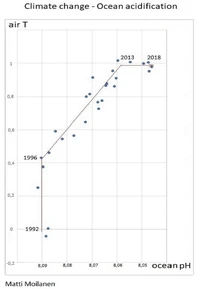
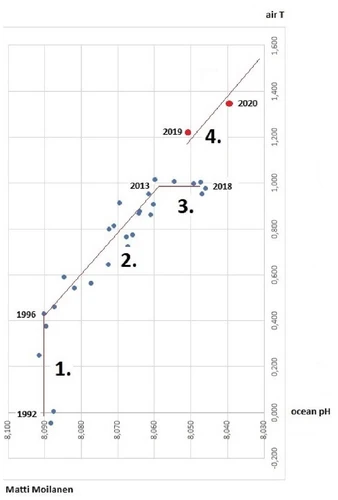
The book is a study about the radical changes in climate change during the past 3 years. The last changes are very concerning, they suggest that the critical point has been crossed: the carbon dioxide in the air keeps on rising and the ocean acidity value pH has gone under 8.3. It is the value where the active carbon components in the water change. This in turn weakens the oceans' capability to buffer energy chemically permanently unless we don't get the acidity value pH to rise again over 8.3.
This study is based on the book I wrote 2 years ago about the dependencies between carbon dioxide in the air and acidification of oceans.
The name of the book is "Climate change - ocean acidity". It is written using a mathematical approach to find out the essential factors. The models I used ended just before the great changes and couldn't forecast these two years. The models didn't include the knowledge of discontinuity points of ocean acidity because the models time period ended just to the first of them in history of registered climate history.
This study tries to elucidate the situation where we are now and what are we heading from now on.
The book is a study about the radical changes in climate change during the past 3 years. The last changes are very concerning, they suggest that the critical point has been crossed: the carbon dioxide in the air keeps on rising and the ocean acidity value pH has gone under 8.3. It is the value where the active carbon components in the water change. This in turn weakens the oceans' capability to buffer energy chemically permanently unless we don't get the acidity value pH to rise again over 8.3.
This study is based on the book I wrote 2 years ago about the dependencies between carbon dioxide in the air and acidification of oceans.
The name of the book is "Climate change - ocean acidity". It is written using a mathematical approach to find out the essential factors. The models I used ended just before the great changes and couldn't forecast these two years. The models didn't include the knowledge of discontinuity points of ocean acidity because the models time period ended just to the first of them in history of registered climate history.
This study tries to elucidate the situation where we are now and what are we heading from now on.

 , qui est-ce ?