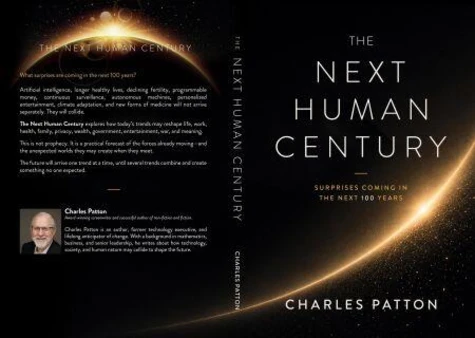
What will human life look like a hundred years from now-and what forces are already pushing us there?In The Next Human Century, Charles Patton examines the accelerating trends that may reshape nearly every part of human life. Artificial intelligence, longer lifespans, automation, changing work, concentrated wealth, new forms of education, abundant energy, political instability, environmental pressures, war, culture, and human enhancement are not separate developments.
They are interconnected forces, each influencing the others and together creating a future that may look radically different from the world we know today. The pace of change itself is one of the most important stories of our time. Advances that once unfolded over generations can now transform industries, institutions, and everyday life within years. Artificial intelligence may take over tasks once thought uniquely human.
Medical and biological advances may extend healthy life and alter our expectations about aging. Automation could change not only how we work, but whether traditional employment remains the primary way most people earn a living. At the same time, these advances may intensify questions about ownership, inequality, political power, and who ultimately benefits from technological progress. Rather than offering a single prediction, Patton follows the direction of major trends and asks where they may lead if they continue.
What happens when machines can perform much of today's work? How will longer lives change careers, families, retirement, and relationships between generations? What happens to wealth and political influence as technology becomes more capable and ownership becomes more concentrated? How might education change when knowledge is instantly available? What happens when energy becomes more abundant, human beings can increasingly modify their own bodies, and governments struggle to keep pace with technologies that cross borders almost effortlessly?The book also considers the less predictable forces that could disrupt humanity's trajectory: geopolitical conflict, environmental change, natural disasters, social instability, and technologies whose consequences may be difficult to anticipate before they are widely adopted.
Progress rarely follows a straight line, and the same innovations that solve one problem often create entirely new ones. Yet The Next Human Century is not simply a catalog of predictions. It is an examination of choices. Technology may expand what humanity is capable of doing, but human decisions will still determine how those capabilities are used, who controls them, and how their benefits and risks are distributed.
The Next Human Century is a wide-ranging exploration of possibility, consequence, and choice-an invitation to look beyond today's headlines, follow the forces already shaping tomorrow, and consider the kind of world we may be creating for the generations that follow.
What will human life look like a hundred years from now-and what forces are already pushing us there?In The Next Human Century, Charles Patton examines the accelerating trends that may reshape nearly every part of human life. Artificial intelligence, longer lifespans, automation, changing work, concentrated wealth, new forms of education, abundant energy, political instability, environmental pressures, war, culture, and human enhancement are not separate developments.
They are interconnected forces, each influencing the others and together creating a future that may look radically different from the world we know today. The pace of change itself is one of the most important stories of our time. Advances that once unfolded over generations can now transform industries, institutions, and everyday life within years. Artificial intelligence may take over tasks once thought uniquely human.
Medical and biological advances may extend healthy life and alter our expectations about aging. Automation could change not only how we work, but whether traditional employment remains the primary way most people earn a living. At the same time, these advances may intensify questions about ownership, inequality, political power, and who ultimately benefits from technological progress. Rather than offering a single prediction, Patton follows the direction of major trends and asks where they may lead if they continue.
What happens when machines can perform much of today's work? How will longer lives change careers, families, retirement, and relationships between generations? What happens to wealth and political influence as technology becomes more capable and ownership becomes more concentrated? How might education change when knowledge is instantly available? What happens when energy becomes more abundant, human beings can increasingly modify their own bodies, and governments struggle to keep pace with technologies that cross borders almost effortlessly?The book also considers the less predictable forces that could disrupt humanity's trajectory: geopolitical conflict, environmental change, natural disasters, social instability, and technologies whose consequences may be difficult to anticipate before they are widely adopted.
Progress rarely follows a straight line, and the same innovations that solve one problem often create entirely new ones. Yet The Next Human Century is not simply a catalog of predictions. It is an examination of choices. Technology may expand what humanity is capable of doing, but human decisions will still determine how those capabilities are used, who controls them, and how their benefits and risks are distributed.
The Next Human Century is a wide-ranging exploration of possibility, consequence, and choice-an invitation to look beyond today's headlines, follow the forces already shaping tomorrow, and consider the kind of world we may be creating for the generations that follow.