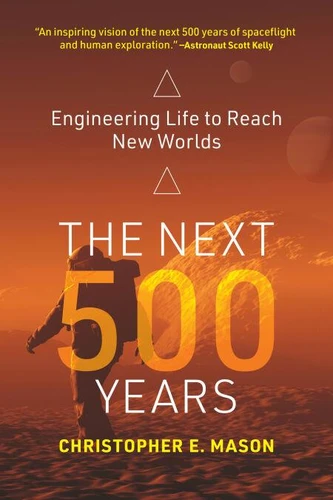
The Next 500 Years. Engineering Life to Reach New Worlds
Par :Formats :
Disponible dans votre compte client Decitre ou Furet du Nord dès validation de votre commande. Le format ePub protégé est :
- Compatible avec une lecture sur My Vivlio (smartphone, tablette, ordinateur)
- Compatible avec une lecture sur liseuses Vivlio
- Pour les liseuses autres que Vivlio, vous devez utiliser le logiciel Adobe Digital Edition. Non compatible avec la lecture sur les liseuses Kindle, Remarkable et Sony
- Non compatible avec un achat hors France métropolitaine
 , qui est-ce ?
Notre partenaire de plateforme de lecture numérique où vous retrouverez l'ensemble de vos ebooks gratuitement
Pour en savoir plus sur nos ebooks, consultez notre aide en ligne ici
C'est si simple ! Lisez votre ebook avec l'app Vivlio sur votre tablette, mobile ou ordinateur :

- Nombre de pages296
- FormatePub
- ISBN978-0-262-36006-7
- EAN9780262360067
- Date de parution20/04/2021
- Protection num.Adobe DRM
- Taille2 Mo
- Infos supplémentairesepub
- ÉditeurThe MIT Press
Résumé
Introducing a 10-phase, 500-year vision for the future of space exploration, genetic engineering, and the human species-on Earth and on other planets. As the only species aware that life on Earth has an expiration date, we have a moral duty to land on, to live on, and to extend life to other planets. Inevitably, life on Earth will come to an end, whether by climate disaster, or by cataclysmic war-or when the sun runs out of fuel in a few billion years.
To avoid extinction, will we have to find a new home planet, perhaps even a new solar system, to inhabit? In this provocative and fascinating book, Christopher Mason argues that we have a moral duty to do just that. Because we are the only species aware that life on Earth has an expiration date, we have a responsibility to act as the shepherd of lifeforms-not only for our species but for all species on which we depend and for those still to come (by accidental or designed evolution).
Mason argues that the same capacity for ingenuity that has enabled us to build rockets and land on other planets can be applied to redesigning biology so that we can sustainably inhabit those planets. And he lays out a 500-year plan for undertaking the massively ambitious project of reengineering human genetics for life in other worlds.
To avoid extinction, will we have to find a new home planet, perhaps even a new solar system, to inhabit? In this provocative and fascinating book, Christopher Mason argues that we have a moral duty to do just that. Because we are the only species aware that life on Earth has an expiration date, we have a responsibility to act as the shepherd of lifeforms-not only for our species but for all species on which we depend and for those still to come (by accidental or designed evolution).
Mason argues that the same capacity for ingenuity that has enabled us to build rockets and land on other planets can be applied to redesigning biology so that we can sustainably inhabit those planets. And he lays out a 500-year plan for undertaking the massively ambitious project of reengineering human genetics for life in other worlds.