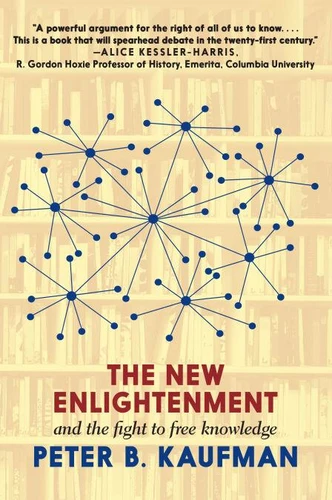
How do we create a universe of truthful and verifiable information, available to everyone?In The New Enlightenment and the Fight to Free Knowledge, MIT Open Learning's Peter B. Kaufman describes the powerful forces that have purposely crippled our efforts to share knowledge widely and freely. Popes and their inquisitors, emperors and their hangmen, commissars and their secret police-throughout history, all have sought to stanch the free flow of information.
Kaufman writes of times when the Bible could not be translated-you'd be burned for trying; when dictionaries and encyclopedias were forbidden; when literature and science and history books were trashed and pulped-sometimes along with their authors; and when efforts to develop public television and radio networks were quashed by private industry. In the 21st century, the enemies of free thought have taken on new and different guises-giant corporate behemoths, sprawling national security agencies, gutted regulatory commissions.
Bereft of any real moral compass or sense of social responsibility, their work to surveil and control us are no less nefarious than their 16th- and 18th- and 20th- century predecessors. They are all part of what Kaufman calls the Monsterverse. The New Enlightenment and the Fight to Free Knowledge maps out the opportunities to mobilize for the fight ahead of us. With the Internet and other means of media production and distribution-video especially-at hand, knowledge institutions like universities, libraries, museums, and archives have a special responsibility now to counter misinformation, disinformation, and fake news-and especially efforts to control the free flow of information. A film and video producer and former book publisher, Kaufman begins to draft a new social contract for our networked video age.
He draws his inspiration from those who fought tooth and nail against earlier incarnations of the Monsterverse-including William Tyndale in the 16th century; Denis Diderot in the 18th; untold numbers of Soviet and Central and East European dissidents in the 20th-many of whom paid the ultimate price. Their successors? Advocates of free knowledge like Aaron Swartz, of free software like Richard Stallman, of an enlightened public television and radio network like James Killian, of a freer Internet like Tim Berners-Lee, of fuller rights and freedoms like Edward Snowden.
All have been striving to secure for us a better world, marked by the right balance between state, society, and private gain. The concluding section of the book, its largest piece, builds on their work, drawing up a progressive agenda for how today's free thinkers can band together now to fight and win. With everything shut and everyone going online, The New Enlightenment and the Fight to Free Knowledge is a rousing call to action that expands the definition of what it means to be a citizen in the 21st century.
How do we create a universe of truthful and verifiable information, available to everyone?In The New Enlightenment and the Fight to Free Knowledge, MIT Open Learning's Peter B. Kaufman describes the powerful forces that have purposely crippled our efforts to share knowledge widely and freely. Popes and their inquisitors, emperors and their hangmen, commissars and their secret police-throughout history, all have sought to stanch the free flow of information.
Kaufman writes of times when the Bible could not be translated-you'd be burned for trying; when dictionaries and encyclopedias were forbidden; when literature and science and history books were trashed and pulped-sometimes along with their authors; and when efforts to develop public television and radio networks were quashed by private industry. In the 21st century, the enemies of free thought have taken on new and different guises-giant corporate behemoths, sprawling national security agencies, gutted regulatory commissions.
Bereft of any real moral compass or sense of social responsibility, their work to surveil and control us are no less nefarious than their 16th- and 18th- and 20th- century predecessors. They are all part of what Kaufman calls the Monsterverse. The New Enlightenment and the Fight to Free Knowledge maps out the opportunities to mobilize for the fight ahead of us. With the Internet and other means of media production and distribution-video especially-at hand, knowledge institutions like universities, libraries, museums, and archives have a special responsibility now to counter misinformation, disinformation, and fake news-and especially efforts to control the free flow of information. A film and video producer and former book publisher, Kaufman begins to draft a new social contract for our networked video age.
He draws his inspiration from those who fought tooth and nail against earlier incarnations of the Monsterverse-including William Tyndale in the 16th century; Denis Diderot in the 18th; untold numbers of Soviet and Central and East European dissidents in the 20th-many of whom paid the ultimate price. Their successors? Advocates of free knowledge like Aaron Swartz, of free software like Richard Stallman, of an enlightened public television and radio network like James Killian, of a freer Internet like Tim Berners-Lee, of fuller rights and freedoms like Edward Snowden.
All have been striving to secure for us a better world, marked by the right balance between state, society, and private gain. The concluding section of the book, its largest piece, builds on their work, drawing up a progressive agenda for how today's free thinkers can band together now to fight and win. With everything shut and everyone going online, The New Enlightenment and the Fight to Free Knowledge is a rousing call to action that expands the definition of what it means to be a citizen in the 21st century.

 , qui est-ce ?
