SOLDES
Jusqu'à -70% sur une sélection d'articles*

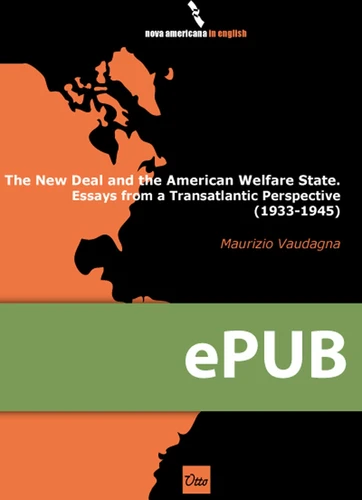
The New Deal and the American Welfare State. Essays from a Transatlantic Perspective (1933-1945)
Par :Formats :
Disponible dans votre compte client Decitre ou Furet du Nord dès validation de votre commande. Le format PDF est :
- Compatible avec une lecture sur My Vivlio (smartphone, tablette, ordinateur)
- Compatible avec une lecture sur liseuses Vivlio
- Pour les liseuses autres que Vivlio, vous devez utiliser le logiciel Adobe Digital Edition. Non compatible avec la lecture sur les liseuses Kindle, Remarkable et Sony
 , qui est-ce ?
Notre partenaire de plateforme de lecture numérique où vous retrouverez l'ensemble de vos ebooks gratuitement
Pour en savoir plus sur nos ebooks, consultez notre aide en ligne ici
C'est si simple ! Lisez votre ebook avec l'app Vivlio sur votre tablette, mobile ou ordinateur :

- FormatPDF
- ISBN978-88-95285-51-1
- EAN9788895285511
- Date de parution01/09/2014
- Protection num.Digital Watermarking
- Taille2 Mo
- Infos supplémentairespdf
- ÉditeurOtto
Résumé
This book examines the "Age of Roosevelt" through essays published over more than thirty years of scholarship and consequently reveals how historical interpretations of these pivotal decades have changed since the late 1970s. The "Age of Roosevelt, " which encompassed both the Great Depression and World War II, was a prolonged emergency that marked a turning point in the history of the twentieth century.
This twelve-year period represented the climax of the worldwide confrontation between initially competing and later warring principles of public and personal life: liberal democracy, fascism and bolshevism. The "Old World" was increasingly engulfed in the "European tragedy" of dictatorship, aggressive nationalism and racism, with World War II only aggravating what has been called the "European decline." At the same time, by contrast, the concept of the "American Century" was being progressively established.
During the twelve-year "age of Roosevelt" the United States went from being a "sick nation" in the early 1930s, coinciding with the start of the century's worst worldwide depression, to the most powerful country in the world. To make this happen, Franklin D. Roosevelt used the New Deal to develop a new style of leadership, a new relationship between government and society, and a new discourse on American identity.
In fact, Roosevelt's New Deal transformed the United States from a quintessential "latecomer" in terms of social policy into the leader of a new liberal-democratic system of social protection that opposed the system promoted by the European dictators.
This twelve-year period represented the climax of the worldwide confrontation between initially competing and later warring principles of public and personal life: liberal democracy, fascism and bolshevism. The "Old World" was increasingly engulfed in the "European tragedy" of dictatorship, aggressive nationalism and racism, with World War II only aggravating what has been called the "European decline." At the same time, by contrast, the concept of the "American Century" was being progressively established.
During the twelve-year "age of Roosevelt" the United States went from being a "sick nation" in the early 1930s, coinciding with the start of the century's worst worldwide depression, to the most powerful country in the world. To make this happen, Franklin D. Roosevelt used the New Deal to develop a new style of leadership, a new relationship between government and society, and a new discourse on American identity.
In fact, Roosevelt's New Deal transformed the United States from a quintessential "latecomer" in terms of social policy into the leader of a new liberal-democratic system of social protection that opposed the system promoted by the European dictators.