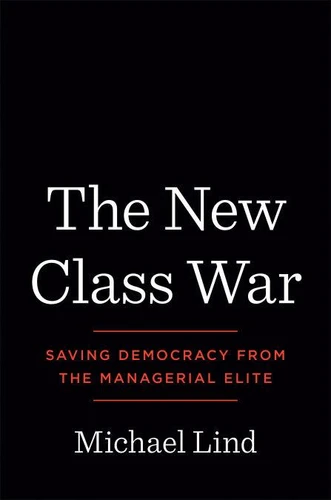
The New Class War. Saving Democracy from the Managerial Elite
Par :Formats :
Disponible dans votre compte client Decitre ou Furet du Nord dès validation de votre commande. Le format ePub protégé est :
- Compatible avec une lecture sur My Vivlio (smartphone, tablette, ordinateur)
- Compatible avec une lecture sur liseuses Vivlio
- Pour les liseuses autres que Vivlio, vous devez utiliser le logiciel Adobe Digital Edition. Non compatible avec la lecture sur les liseuses Kindle, Remarkable et Sony
- Non compatible avec un achat hors France métropolitaine
 , qui est-ce ?
Notre partenaire de plateforme de lecture numérique où vous retrouverez l'ensemble de vos ebooks gratuitement
Pour en savoir plus sur nos ebooks, consultez notre aide en ligne ici
C'est si simple ! Lisez votre ebook avec l'app Vivlio sur votre tablette, mobile ou ordinateur :

- Nombre de pages224
- FormatePub
- ISBN978-0-593-08370-3
- EAN9780593083703
- Date de parution21/01/2020
- Protection num.Adobe DRM
- Taille603 Ko
- Infos supplémentairesepub
- ÉditeurPortfolio
Résumé
In both Europe and North America, populist movements have shattered existing party systems and thrown governments into turmoil. The embattled establishment claims that these populist insurgencies seek to overthrow liberal democracy. The truth is no less alarming but is more complex: Western democracies are being torn apart by a new class war. In this controversial and groundbreaking new analysis, Michael Lind, one of America's leading thinkers, debunks the idea that the insurgencies are primarily the result of bigotry, traces how the breakdown of mid-century class compromises between business and labor led to the conflict, and reveals the real battle lines.
On one side is the managerial overclass-the university-credentialed elite that clusters in high-income hubs and dominates government, the economy and the culture. On the other side is the working class of the low-density heartlands-mostly, but not exclusively, native and white. The two classes clash over immigration, trade, the environment, and social values, and the managerial class has had the upper hand.
As a result of the half-century decline of the institutions that once empowered the working class, power has shifted to the institutions the overclass controls: corporations, executive and judicial branches, universities, and the media. The class war can resolve in one of three ways: . The triumph of the overclass, resulting in a high-tech caste system. . The empowerment of populist, resulting in no constructive reforms . A class compromise that provides the working class with real power Lind argues that Western democracies must incorporate working-class majorities of all races, ethnicities, and creeds into decision making in politics, the economy, and culture.
Only this class compromise can avert a never-ending cycle of clashes between oligarchs and populists and save democracy.
On one side is the managerial overclass-the university-credentialed elite that clusters in high-income hubs and dominates government, the economy and the culture. On the other side is the working class of the low-density heartlands-mostly, but not exclusively, native and white. The two classes clash over immigration, trade, the environment, and social values, and the managerial class has had the upper hand.
As a result of the half-century decline of the institutions that once empowered the working class, power has shifted to the institutions the overclass controls: corporations, executive and judicial branches, universities, and the media. The class war can resolve in one of three ways: . The triumph of the overclass, resulting in a high-tech caste system. . The empowerment of populist, resulting in no constructive reforms . A class compromise that provides the working class with real power Lind argues that Western democracies must incorporate working-class majorities of all races, ethnicities, and creeds into decision making in politics, the economy, and culture.
Only this class compromise can avert a never-ending cycle of clashes between oligarchs and populists and save democracy.