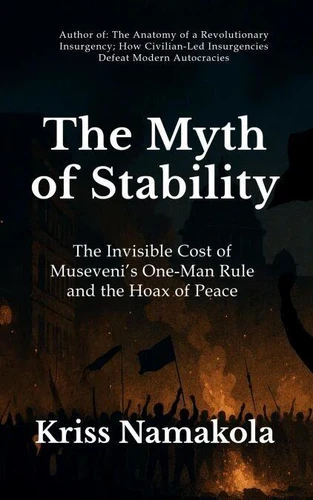
The Myth of Stability, The Invisible Cost of Museveni’s One-Man Rule in Uganda and the Hoax of Peace - Kriss Namakola
Par :Formats :
Disponible dans votre compte client Decitre ou Furet du Nord dès validation de votre commande. Le format ePub est :
- Compatible avec une lecture sur My Vivlio (smartphone, tablette, ordinateur)
- Compatible avec une lecture sur liseuses Vivlio
- Pour les liseuses autres que Vivlio, vous devez utiliser le logiciel Adobe Digital Edition. Non compatible avec la lecture sur les liseuses Kindle, Remarkable et Sony
 , qui est-ce ?
Notre partenaire de plateforme de lecture numérique où vous retrouverez l'ensemble de vos ebooks gratuitement
Pour en savoir plus sur nos ebooks, consultez notre aide en ligne ici
C'est si simple ! Lisez votre ebook avec l'app Vivlio sur votre tablette, mobile ou ordinateur :

- FormatePub
- ISBN8233867606
- EAN9798233867606
- Date de parution01/03/2026
- Protection num.pas de protection
- Infos supplémentairesepub
- ÉditeurLinda Balsamo
Résumé
For decades, Uganda has been presented as a model of stability in a turbulent region. Western governments cite security cooperation. Donors point to macroeconomic reforms. The regime speaks of peace. This book challenges that narrative. The Myth of Stability examines the political system built under Yoweri Museveni and asks a direct question: what has this stability cost? Through documented analysis of governance, patronage networks, security structures, corruption, and the management of opposition, the book argues that what appears to be order is sustained through centralized power, managed elections, and systematic repression.
The expansion of the national budget has not translated into equitable service delivery. Institutions have weakened. Independent centers of power have been absorbed or dismantled. Political competition has narrowed. Public debt has risen while accountability mechanisms struggle to function. Beneath the language of peace lies a structure designed to preserve one-man rule. Drawing on historical context, policy analysis, and political developments over nearly four decades, this work explores how modern authoritarian systems maintain legitimacy while limiting democratic space.
It situates Uganda within the broader conversation about democratic backsliding, regime survival, and the global debate over stability versus freedom. This book is intended for readers interested in African politics, governance, democracy, and state power. It speaks to scholars, policymakers, activists, and citizens seeking a deeper understanding of how political permanence is constructed-and what it means for a nation's future.
The expansion of the national budget has not translated into equitable service delivery. Institutions have weakened. Independent centers of power have been absorbed or dismantled. Political competition has narrowed. Public debt has risen while accountability mechanisms struggle to function. Beneath the language of peace lies a structure designed to preserve one-man rule. Drawing on historical context, policy analysis, and political developments over nearly four decades, this work explores how modern authoritarian systems maintain legitimacy while limiting democratic space.
It situates Uganda within the broader conversation about democratic backsliding, regime survival, and the global debate over stability versus freedom. This book is intended for readers interested in African politics, governance, democracy, and state power. It speaks to scholars, policymakers, activists, and citizens seeking a deeper understanding of how political permanence is constructed-and what it means for a nation's future.