SOLDES
Jusqu'à -70% sur une sélection d'articles*

Nouveauté
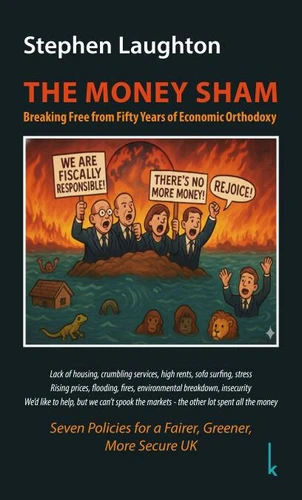
The Money Sham. Breaking Free from Fifty Years of Economic Orthodoxy
Par :Formats :
Disponible dans votre compte client Decitre ou Furet du Nord dès validation de votre commande. Le format ePub est :
- Compatible avec une lecture sur My Vivlio (smartphone, tablette, ordinateur)
- Compatible avec une lecture sur liseuses Vivlio
- Pour les liseuses autres que Vivlio, vous devez utiliser le logiciel Adobe Digital Edition. Non compatible avec la lecture sur les liseuses Kindle, Remarkable et Sony
 , qui est-ce ?
Notre partenaire de plateforme de lecture numérique où vous retrouverez l'ensemble de vos ebooks gratuitement
Pour en savoir plus sur nos ebooks, consultez notre aide en ligne ici
C'est si simple ! Lisez votre ebook avec l'app Vivlio sur votre tablette, mobile ou ordinateur :

- Nombre de pages362
- FormatePub
- ISBN978-3-944203-96-6
- EAN9783944203966
- Date de parution21/05/2026
- Protection num.Digital Watermarking
- Taille11 Mo
- Infos supplémentairesepub
- ÉditeurLola Books
Résumé
The Money Sham is not just a theoretical exploration of "what money is." It is a political-economic history of how misunderstandings about money have shaped Britain's economic trajectory. Stephen Laughton reveals a persistent pattern in which flawed ideas about money have guided policy decisions across generations.
The book exposes a hidden continuity from Isaac Newton's monetary framework through to Thatcherism, New Labour, and Conservative austerity, to Labour 2024.
The book details the UK Labour Party's reactive and inadequate response to free-market ideology over the decades. This response is echoed across western democracies. The ascendancy of Currency School ideas over those of the Banking School and the eventual triumph of neo-liberal economics has driven the most consequential policy mistakes, contributing to crises, stagnation, instability, and avoidable social and economic pressures. At a moment when Britain has once again placed its hopes in a government at risk of repeating these errors, The Money Sham offers a clear account of the country's current crisis alongside a concrete, evidence-based programme for renewal, grounded in monetary realism, real-resource economics, and the practical realities of British institutions.
The book details the UK Labour Party's reactive and inadequate response to free-market ideology over the decades. This response is echoed across western democracies. The ascendancy of Currency School ideas over those of the Banking School and the eventual triumph of neo-liberal economics has driven the most consequential policy mistakes, contributing to crises, stagnation, instability, and avoidable social and economic pressures. At a moment when Britain has once again placed its hopes in a government at risk of repeating these errors, The Money Sham offers a clear account of the country's current crisis alongside a concrete, evidence-based programme for renewal, grounded in monetary realism, real-resource economics, and the practical realities of British institutions.