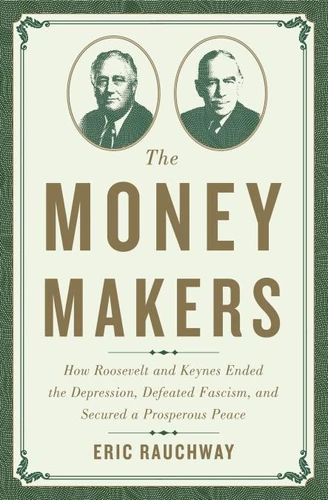
The Money Makers. How Roosevelt and Keynes Ended the Depression, Defeated Fascism, and Secured a Prosperous Peace
Par :Formats :
Disponible dans votre compte client Decitre ou Furet du Nord dès validation de votre commande. Le format ePub protégé est :
- Compatible avec une lecture sur My Vivlio (smartphone, tablette, ordinateur)
- Compatible avec une lecture sur liseuses Vivlio
- Pour les liseuses autres que Vivlio, vous devez utiliser le logiciel Adobe Digital Edition. Non compatible avec la lecture sur les liseuses Kindle, Remarkable et Sony
- Non compatible avec un achat hors France métropolitaine
 , qui est-ce ?
Notre partenaire de plateforme de lecture numérique où vous retrouverez l'ensemble de vos ebooks gratuitement
Pour en savoir plus sur nos ebooks, consultez notre aide en ligne ici
C'est si simple ! Lisez votre ebook avec l'app Vivlio sur votre tablette, mobile ou ordinateur :

- Nombre de pages336
- FormatePub
- ISBN978-0-465-06156-3
- EAN9780465061563
- Date de parution26/10/2015
- Protection num.Adobe DRM
- Infos supplémentairesepub
- ÉditeurBasic Books
Résumé
Shortly after arriving in the White House in early 1933, Franklin Roosevelt took the United States off the gold standard. His opponents thought his decision unwise at best, and ruinous at worst. But they could not have been more wrong. With The Money Makers, Eric Rauchway tells the absorbing story of how FDR and his advisors pulled the levers of monetary policy to save the domestic economy and propel the United States to unprecedented prosperity and superpower status.
Drawing on the ideas of the brilliant British economist John Maynard Keynes, among others, Roosevelt created the conditions for recovery from the Great Depression, deploying economic policy to fight the biggest threat then facing the nation: deflation. Throughout the 1930s, he also had one eye on the increasingly dire situation in Europe. In order to defeat Hitler, Roosevelt turned again to monetary policy, sending dollars abroad to prop up the faltering economies of Britain and, beginning in 1941, the Soviet Union.
FDR's fight against economic depression and his fight against fascism were indistinguishable. As Rauchway writes, "Roosevelt wanted to ensure more than business recovery; he wanted to restore American economic and moral strength so the US could defend civilization itself." The economic and military alliance he created proved unbeatable-and also provided the foundation for decades of postwar prosperity.
Indeed, Rauchway argues that Roosevelt's greatest legacy was his monetary policy. Even today, the "Roosevelt dollar" remains both the symbol and the catalyst of America's vast economic power. The Money Makers restores the Roosevelt dollar to its central place in our understanding of FDR, the New Deal, and the economic history of twentieth-century America. We forget this history at our own peril. In revealing the roots of our postwar prosperity, Rauchway shows how we can recapture the abundance of that period in our own.
Drawing on the ideas of the brilliant British economist John Maynard Keynes, among others, Roosevelt created the conditions for recovery from the Great Depression, deploying economic policy to fight the biggest threat then facing the nation: deflation. Throughout the 1930s, he also had one eye on the increasingly dire situation in Europe. In order to defeat Hitler, Roosevelt turned again to monetary policy, sending dollars abroad to prop up the faltering economies of Britain and, beginning in 1941, the Soviet Union.
FDR's fight against economic depression and his fight against fascism were indistinguishable. As Rauchway writes, "Roosevelt wanted to ensure more than business recovery; he wanted to restore American economic and moral strength so the US could defend civilization itself." The economic and military alliance he created proved unbeatable-and also provided the foundation for decades of postwar prosperity.
Indeed, Rauchway argues that Roosevelt's greatest legacy was his monetary policy. Even today, the "Roosevelt dollar" remains both the symbol and the catalyst of America's vast economic power. The Money Makers restores the Roosevelt dollar to its central place in our understanding of FDR, the New Deal, and the economic history of twentieth-century America. We forget this history at our own peril. In revealing the roots of our postwar prosperity, Rauchway shows how we can recapture the abundance of that period in our own.