
Nouveauté
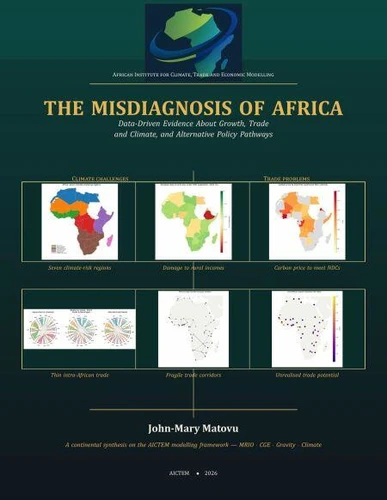
THE MISDIAGNOSIS OF AFRICA: Data‑Driven Evidence About Growth, Trade and Climate, and Alternative Policy Pathways
Par :Formats :
Disponible dans votre compte client Decitre ou Furet du Nord dès validation de votre commande. Le format ePub est :
- Compatible avec une lecture sur My Vivlio (smartphone, tablette, ordinateur)
- Compatible avec une lecture sur liseuses Vivlio
- Pour les liseuses autres que Vivlio, vous devez utiliser le logiciel Adobe Digital Edition. Non compatible avec la lecture sur les liseuses Kindle, Remarkable et Sony
 , qui est-ce ?
Notre partenaire de plateforme de lecture numérique où vous retrouverez l'ensemble de vos ebooks gratuitement
Pour en savoir plus sur nos ebooks, consultez notre aide en ligne ici
C'est si simple ! Lisez votre ebook avec l'app Vivlio sur votre tablette, mobile ou ordinateur :

- FormatePub
- ISBN8235465992
- EAN9798235465992
- Date de parution14/07/2026
- Protection num.pas de protection
- Infos supplémentairesepub
- ÉditeurIoakim Ioakim
Résumé
Africa enters the second quarter of the twenty-first century as the youngest region on Earth and, at the sametime, as the region least responsible for the climate crisis yet most exposed to its effects. By 2050 one in fourpeople alive will be African, the continent's labour force will be the largest in the world, and its cities willhave taken in several hundred million new residents. Whether that demographic wave becomes a dividendor a disaster depends on choices made in the next two decades: how Africa produces, how it trades, and howit adapts to a warming planet.
I have written this book because I do not think those three questions can be answered separately. For half acentury, Africa's development debate has run in silos. Growth economists studied structural transformationand the stubborn persistence of low-productivity agriculture. Trade economists asked why a continent of fiftyfoureconomies trades so little with itself. Climate scientists and finance specialists measured vulnerability, adaptation and the gap between what African governments have pledged and what they can actually payfor.
Each conversation built its own models, its own datasets, its own conferences, and, inevitably, its ownblind spots. Those silos did more than fragment the analysis. For half a century they produced a development practicethat repeatedly diagnosed the wrong disease and prescribed the wrong cure, and Africa's governments andtheir donors got it wrong together. Aid and advice pushed clinics and classrooms ahead of factories, asthough human capital could substitute for the productive base that is supposed to employ it, when themodels in this book rank manufacturing and agro-processing far above social spending as engines of growth.
Trade reform was sold as tariff-cutting, culminating in a continental free-trade area built around zero tariffs, even though the evidence here shows that removing tariffs moves intra-African trade by almost nothing whilethe barriers that actually bind, border delays, non-tariff measures and missing corridors, went unaddressed. And on climate, a continent that contributed least to the problem was pressed to cut emissions it neverproduced, while the adaptation spending that would actually protect African incomes, and the loss-anddamageowed for warming already locked in, went unpaid.
This book is, in that sense, a second opinion: oneconsistent diagnosis of what has held African development back, and a prescription that follows from theevidence rather than from doctrine. My argument is that the three transformations Africa must achieve are really one problem. A structuraltransformation moves production from primary commodities to higher-productivity activity. A trade transformationmoves the continent from extraversion towards regional integration.
A climate transformationmoves it towards resilience and low-carbon growth. These are not three agendas competing for attention;they are the same agenda seen from three angles. The factory that adds value to a cocoa bean is the factorythat needs reliable, increasingly renewable power. The corridor that lets a Zambian firm sell into the DemocraticRepublic of Congo is the corridor a flood can cut. The critical minerals the global energy transitiondepends on sit under African soil, and whether they leave as raw ore or as processed precursors will decidewhether the green transition repeats the colonial economic pattern or finally breaks that pattern.
I have written this book because I do not think those three questions can be answered separately. For half acentury, Africa's development debate has run in silos. Growth economists studied structural transformationand the stubborn persistence of low-productivity agriculture. Trade economists asked why a continent of fiftyfoureconomies trades so little with itself. Climate scientists and finance specialists measured vulnerability, adaptation and the gap between what African governments have pledged and what they can actually payfor.
Each conversation built its own models, its own datasets, its own conferences, and, inevitably, its ownblind spots. Those silos did more than fragment the analysis. For half a century they produced a development practicethat repeatedly diagnosed the wrong disease and prescribed the wrong cure, and Africa's governments andtheir donors got it wrong together. Aid and advice pushed clinics and classrooms ahead of factories, asthough human capital could substitute for the productive base that is supposed to employ it, when themodels in this book rank manufacturing and agro-processing far above social spending as engines of growth.
Trade reform was sold as tariff-cutting, culminating in a continental free-trade area built around zero tariffs, even though the evidence here shows that removing tariffs moves intra-African trade by almost nothing whilethe barriers that actually bind, border delays, non-tariff measures and missing corridors, went unaddressed. And on climate, a continent that contributed least to the problem was pressed to cut emissions it neverproduced, while the adaptation spending that would actually protect African incomes, and the loss-anddamageowed for warming already locked in, went unpaid.
This book is, in that sense, a second opinion: oneconsistent diagnosis of what has held African development back, and a prescription that follows from theevidence rather than from doctrine. My argument is that the three transformations Africa must achieve are really one problem. A structuraltransformation moves production from primary commodities to higher-productivity activity. A trade transformationmoves the continent from extraversion towards regional integration.
A climate transformationmoves it towards resilience and low-carbon growth. These are not three agendas competing for attention;they are the same agenda seen from three angles. The factory that adds value to a cocoa bean is the factorythat needs reliable, increasingly renewable power. The corridor that lets a Zambian firm sell into the DemocraticRepublic of Congo is the corridor a flood can cut. The critical minerals the global energy transitiondepends on sit under African soil, and whether they leave as raw ore or as processed precursors will decidewhether the green transition repeats the colonial economic pattern or finally breaks that pattern.