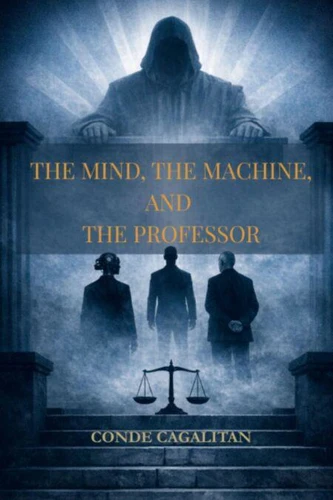
Can a machine be guilty of anything?That's the question on trial - in a courtroom that exists nowhere and everywhere, where three witnesses take the stand: a Mind that remembers being human, a Machine built to answer without ever understanding, and a Professor who taught the difference his whole life and still can't prove it. One of them is lying. Not about the facts - about what the facts mean. The Machine's answers are flawless.
That's what makes them dangerous. The Professor's expertise is real. That's what makes his blind spot worse. The Mind's only defense is the one thing a machine can never fake: it can be wrong, and know it. The trial opens with the Machine. Every question, answered instantly. Every answer, correct. And somewhere around the third flawless response, the court realizes the horror of it: nothing behind the answers is listening.
The Machine has never once been uncertain - which means it has never once actually known anything either. Then the Professor takes the stand, certain this will be easy. He has spent his career studying exactly this distinction - the line between processing and understanding, between output and thought. But the questions don't stay in his territory for long. Soon he's being asked not what the Mind and the Machine are, but what he is - and for the first time in his career, his own certainty runs out of road.
Finally, the Mind. No flawless answers. No decades of theory to hide behind. Just one thing the other two witnesses cannot offer: doubt. The willingness to be wrong, to be corrected, to carry the weight of an answer that might not hold up under the next question. It shouldn't be enough to win a trial like this. It might be the only thing that can. As the cross-examination tightens, the courtroom stops being a metaphor.
You're not reading the trial. You're sitting in it - asked, along with the witnesses, to answer the question underneath all the others:If something can simulate understanding perfectly, does the difference even matter anymore?The court is waiting for your verdict.
Can a machine be guilty of anything?That's the question on trial - in a courtroom that exists nowhere and everywhere, where three witnesses take the stand: a Mind that remembers being human, a Machine built to answer without ever understanding, and a Professor who taught the difference his whole life and still can't prove it. One of them is lying. Not about the facts - about what the facts mean. The Machine's answers are flawless.
That's what makes them dangerous. The Professor's expertise is real. That's what makes his blind spot worse. The Mind's only defense is the one thing a machine can never fake: it can be wrong, and know it. The trial opens with the Machine. Every question, answered instantly. Every answer, correct. And somewhere around the third flawless response, the court realizes the horror of it: nothing behind the answers is listening.
The Machine has never once been uncertain - which means it has never once actually known anything either. Then the Professor takes the stand, certain this will be easy. He has spent his career studying exactly this distinction - the line between processing and understanding, between output and thought. But the questions don't stay in his territory for long. Soon he's being asked not what the Mind and the Machine are, but what he is - and for the first time in his career, his own certainty runs out of road.
Finally, the Mind. No flawless answers. No decades of theory to hide behind. Just one thing the other two witnesses cannot offer: doubt. The willingness to be wrong, to be corrected, to carry the weight of an answer that might not hold up under the next question. It shouldn't be enough to win a trial like this. It might be the only thing that can. As the cross-examination tightens, the courtroom stops being a metaphor.
You're not reading the trial. You're sitting in it - asked, along with the witnesses, to answer the question underneath all the others:If something can simulate understanding perfectly, does the difference even matter anymore?The court is waiting for your verdict.

 , qui est-ce ?