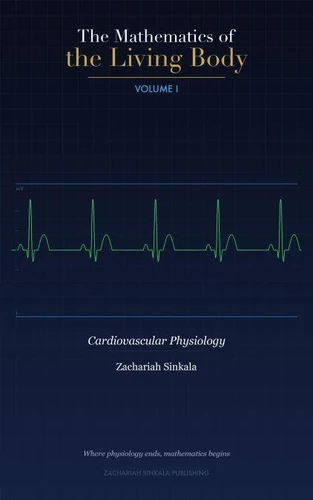
The Mathematics of the Living Body, Volume 1: Cardiovascular PhysiologyThis is a physiology book written in equations. Not a mathematics textbook that uses the heart as a worked example - the physiology comes first, always. Every equation in the book emerges from a named protein, a measurable cellular event, or a conservation law that the biology makes necessary. The mathematics follows because it is the only honest way to describe what the system is doing.
The central argumentThe cardiovascular system is a control architecture. It is not a collection of organs with properties to memorise. It is a set of feedback loops, setpoints, and dynamical subsystems - a pressure-controlled pump connected to a resistance network, regulated by a proportional-integral controller in the brainstem, a hormonal cascade in the kidney, and local autoregulation in every organ.
Once you see it this way, the pharmacology, the pathology, and the clinical decision-making all follow from the same framework. That framing is not new to physiology research. It is almost entirely absent from medical education. Each chapter opens with the molecular biology - named genes, named proteins, named mechanisms - before any equation appears. Each carries an explicit Model Assumptions box distinguishing core physical principles from useful approximations from empirical fits.
Worked examples report ranges, not single numbers. The reader is a medical student who already knows basic physiology and wants to know why, a biomedical engineering student who wants clinical grounding, or a quantitatively minded clinician who prefers mechanism-first explanations. It is a companion text, not a primary medical textbook - strongest for readers who want the first-principles framework underneath the clinical vocabulary they already have.
Where physiology ends, mathematics begins.
The Mathematics of the Living Body, Volume 1: Cardiovascular PhysiologyThis is a physiology book written in equations. Not a mathematics textbook that uses the heart as a worked example - the physiology comes first, always. Every equation in the book emerges from a named protein, a measurable cellular event, or a conservation law that the biology makes necessary. The mathematics follows because it is the only honest way to describe what the system is doing.
The central argumentThe cardiovascular system is a control architecture. It is not a collection of organs with properties to memorise. It is a set of feedback loops, setpoints, and dynamical subsystems - a pressure-controlled pump connected to a resistance network, regulated by a proportional-integral controller in the brainstem, a hormonal cascade in the kidney, and local autoregulation in every organ.
Once you see it this way, the pharmacology, the pathology, and the clinical decision-making all follow from the same framework. That framing is not new to physiology research. It is almost entirely absent from medical education. Each chapter opens with the molecular biology - named genes, named proteins, named mechanisms - before any equation appears. Each carries an explicit Model Assumptions box distinguishing core physical principles from useful approximations from empirical fits.
Worked examples report ranges, not single numbers. The reader is a medical student who already knows basic physiology and wants to know why, a biomedical engineering student who wants clinical grounding, or a quantitatively minded clinician who prefers mechanism-first explanations. It is a companion text, not a primary medical textbook - strongest for readers who want the first-principles framework underneath the clinical vocabulary they already have.
Where physiology ends, mathematics begins.


 , qui est-ce ?