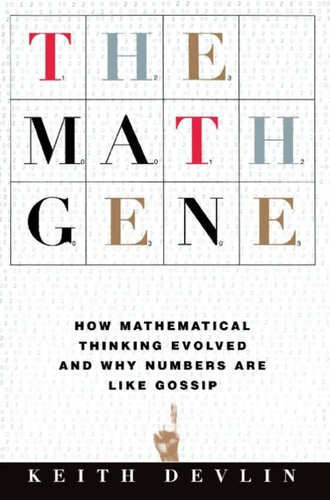
The Math Gene. How Mathematical Thinking Evolved And Why Numbers Are Like Gossip
Par :Formats :
Disponible dans votre compte client Decitre ou Furet du Nord dès validation de votre commande. Le format ePub protégé est :
- Compatible avec une lecture sur My Vivlio (smartphone, tablette, ordinateur)
- Compatible avec une lecture sur liseuses Vivlio
- Pour les liseuses autres que Vivlio, vous devez utiliser le logiciel Adobe Digital Edition. Non compatible avec la lecture sur les liseuses Kindle, Remarkable et Sony
- Non compatible avec un achat hors France métropolitaine
 , qui est-ce ?
Notre partenaire de plateforme de lecture numérique où vous retrouverez l'ensemble de vos ebooks gratuitement
Pour en savoir plus sur nos ebooks, consultez notre aide en ligne ici
C'est si simple ! Lisez votre ebook avec l'app Vivlio sur votre tablette, mobile ou ordinateur :

- Nombre de pages352
- FormatePub
- ISBN0-7867-2508-7
- EAN9780786725083
- Date de parution16/05/2001
- Protection num.Adobe DRM
- Infos supplémentairesepub
- ÉditeurBasic Books
Résumé
If people are endowed with a "number instinct" similar to the "language instinct" -- as recent research suggests -- then why can't everyone do math? In The Math Gene, mathematician and popular writer Keith Devlin attacks both sides of this question. Devlin offers a breathtakingly new theory of language development that describes how language evolved in two stages and how its main purpose was not communication.
Devlin goes on to show that the ability to think mathematically arose out of the same symbol-manipulating ability that was so crucial to the very first emergence of true language. Why, then, can't we do math as well as we speak? The answer, says Devlin, is that we can and do -- we just don't recognize when we're using mathematical reasoning.
Devlin goes on to show that the ability to think mathematically arose out of the same symbol-manipulating ability that was so crucial to the very first emergence of true language. Why, then, can't we do math as well as we speak? The answer, says Devlin, is that we can and do -- we just don't recognize when we're using mathematical reasoning.