SOLDES
Jusqu'à -70% sur une sélection d'articles*

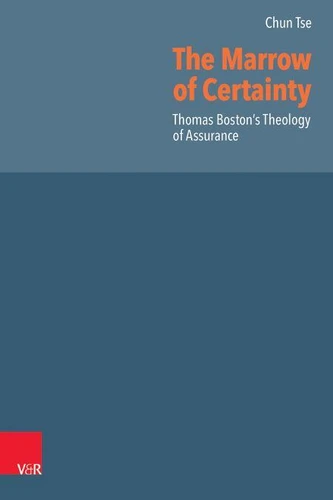
The Marrow of Certainty. Thomas Boston's Theology of Assurance
Par :Formats :
Disponible dans votre compte client Decitre ou Furet du Nord dès validation de votre commande. Le format PDF est :
- Compatible avec une lecture sur My Vivlio (smartphone, tablette, ordinateur)
- Compatible avec une lecture sur liseuses Vivlio
- Pour les liseuses autres que Vivlio, vous devez utiliser le logiciel Adobe Digital Edition. Non compatible avec la lecture sur les liseuses Kindle, Remarkable et Sony
 , qui est-ce ?
Notre partenaire de plateforme de lecture numérique où vous retrouverez l'ensemble de vos ebooks gratuitement
Pour en savoir plus sur nos ebooks, consultez notre aide en ligne ici
C'est si simple ! Lisez votre ebook avec l'app Vivlio sur votre tablette, mobile ou ordinateur :

- Nombre de pages302
- FormatPDF
- ISBN978-3-647-56090-8
- EAN9783647560908
- Date de parution12/06/2023
- Protection num.pas de protection
- Taille4 Mo
- Infos supplémentairespdf
- ÉditeurVandenhoeck & Ruprecht
Résumé
Assurance was a central issue for the eminent Scottish theologian-pastor Thomas Boston long before it emerged as a focal point of the theological debate in the Marrow Controversy. In The Marrow of Certainty, Chun Tse presents the first full-length study of Boston's theology of assurance in six dimensions: trinitarian, covenantal, Christological, soteriological, ecclesiastical, and sacramental. This work not only furnishes the first-ever intellectual biography of Boston in his Scottish context and controversies, but it also cross-studies the theology of the Marrow of Modern Divinity with Boston's notes.
This research argues that Boston's doctrine of assurance centres on union and communion with Christ, the architectonic principle of his theology. The book challenges the common conception that Boston's theology merely follows Calvin, the Scots Confession, the Marrow, the Westminster Standards, and Scottish federalism. Boston, most strikingly, holds in tension assurance as intrinsic to faith-itself a gift from God's sovereignty in election-while insisting on self-examination as a human responsibility.
This salient mark of his doctrine of assurance originates from his assertion that Christ died for the elect alone but all-elect or not-have the warrant to receive Christ. As such, assurance is, theologically, a divine gift and, pastorally, a human endeavour. Certainty is thus both extra nos and intra nos. Boston, this study reveals, has a potent and enduring power to speak on the perennial issue of assurance, rooted in the person of Christ, whom he considers as being the covenant itself.
This research argues that Boston's doctrine of assurance centres on union and communion with Christ, the architectonic principle of his theology. The book challenges the common conception that Boston's theology merely follows Calvin, the Scots Confession, the Marrow, the Westminster Standards, and Scottish federalism. Boston, most strikingly, holds in tension assurance as intrinsic to faith-itself a gift from God's sovereignty in election-while insisting on self-examination as a human responsibility.
This salient mark of his doctrine of assurance originates from his assertion that Christ died for the elect alone but all-elect or not-have the warrant to receive Christ. As such, assurance is, theologically, a divine gift and, pastorally, a human endeavour. Certainty is thus both extra nos and intra nos. Boston, this study reveals, has a potent and enduring power to speak on the perennial issue of assurance, rooted in the person of Christ, whom he considers as being the covenant itself.