
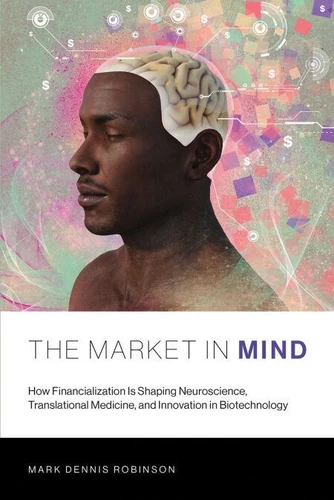
The Market in Mind. How Financialization Is Shaping Neuroscience, Translational Medicine, and Innovation in Biotechnology
Par :Formats :
Disponible dans votre compte client Decitre ou Furet du Nord dès validation de votre commande. Le format ePub protégé est :
- Compatible avec une lecture sur My Vivlio (smartphone, tablette, ordinateur)
- Compatible avec une lecture sur liseuses Vivlio
- Pour les liseuses autres que Vivlio, vous devez utiliser le logiciel Adobe Digital Edition. Non compatible avec la lecture sur les liseuses Kindle, Remarkable et Sony
- Non compatible avec un achat hors France métropolitaine
 , qui est-ce ?
Notre partenaire de plateforme de lecture numérique où vous retrouverez l'ensemble de vos ebooks gratuitement
Pour en savoir plus sur nos ebooks, consultez notre aide en ligne ici
C'est si simple ! Lisez votre ebook avec l'app Vivlio sur votre tablette, mobile ou ordinateur :

- Nombre de pages324
- FormatePub
- ISBN978-0-262-35297-0
- EAN9780262352970
- Date de parution23/07/2019
- Protection num.Adobe DRM
- Taille2 Mo
- Infos supplémentairesepub
- ÉditeurThe MIT Press
Résumé
A critical examination of translational medicine, when private risk is transferred to the public sector and university research teams become tech startups for global investors. A global shift has secretly transformed science and medicine. Starting in 2003, biomedical research in the West has been reshaped by the emergence of translational science and medicine-the idea that the aim of research is to translate findings as quickly as possible into medical products.
In The Market in Mind, Mark Dennis Robinson charts this shift, arguing that the new research paradigm has turned university research teams into small biotechnology startups and their industry partners into early-stage investment firms. There is also a larger, surprising consequence from this shift: according to Robinson, translational science and medicine enable biopharmaceutical firms, as part of a broader financial strategy, to outsource the riskiest parts of research to nonprofit universities.
Robinson examines the implications of this new configuration. What happens, for example, when universities absorb unknown levels of risk? Robinson argues that in the years since the global financial crisis translational science and medicine has brought about "the financialization of health."Robinson explores such topics as shareholder anxiety and industry retreat from Alzheimer's and depression research; how laboratory research is understood as health innovation even when there is no product; the emergence of investor networking events as crucial for viewing science in a market context; and the place of patients in research decisions.
Although translational medicine justifies itself by the goal of relieving patients' suffering, Robinson finds patients' voices largely marginalized in translational neuroscience.
In The Market in Mind, Mark Dennis Robinson charts this shift, arguing that the new research paradigm has turned university research teams into small biotechnology startups and their industry partners into early-stage investment firms. There is also a larger, surprising consequence from this shift: according to Robinson, translational science and medicine enable biopharmaceutical firms, as part of a broader financial strategy, to outsource the riskiest parts of research to nonprofit universities.
Robinson examines the implications of this new configuration. What happens, for example, when universities absorb unknown levels of risk? Robinson argues that in the years since the global financial crisis translational science and medicine has brought about "the financialization of health."Robinson explores such topics as shareholder anxiety and industry retreat from Alzheimer's and depression research; how laboratory research is understood as health innovation even when there is no product; the emergence of investor networking events as crucial for viewing science in a market context; and the place of patients in research decisions.
Although translational medicine justifies itself by the goal of relieving patients' suffering, Robinson finds patients' voices largely marginalized in translational neuroscience.